1,830 posters, 67 videos, 75 audios, 29 topics, 22 sessions, 4,727 authors, 1,697 institutions
ePostersLive by SciGen Technologies S.A. All rights reserved.
RCOG World Congress 2023
June 12 - 14, 2023 | London, UK

EP.0493
Perinatal and two-year neurodevelopmental outcome of cases of mono-chorionic di-amniotic twin pregnancies.
Poster Presenter
Authors
Affiliations
Part of Topic
Fetal Medicine
Perinatal and two-year neurodevelopmental outcome of cases of mono-chorionic di-amniotic twin pregnancies.
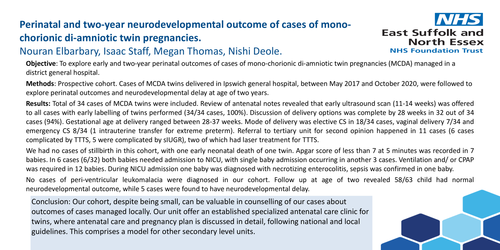
Objective: To explore early and two-year perinatal outcomes of cases of mono-chorionic di-amniotic twin pregnancies (MCDA) managed in a district general hospital.
Methods: Prospective cohort. Cases of MCDA twins delivered in Ipswich general hospital, between May 2017 and October 2020, were followed to explore perinatal outcomes and neurodevelopmental delay at age of two years.
Results: Total of 34 cases of MCDA twins were included. Review of antenatal notes revealed that early ultrasound scan (11-14 weeks) was offered to all cases with early labelling of twins performed (34/34 cases, 100%). Discussion of delivery options was complete by 28 weeks in 32 out of 34 cases (94%). Gestational age at delivery ranged between 28-37 weeks. Mode of delivery was elective CS in 18/34 cases, vaginal delivery 7/34 and emergency CS 8/34 (1 intrauterine transfer for extreme preterm). Referral to tertiary unit for second opinion happened in 11 cases (6 cases complicated by TTTS, 5 were complicated by sIUGR), two of which had laser treatment for TTTS.
We had no cases of stillbirth in this cohort, with one early neonatal death of one twin. Apgar score of less than 7 at 5 minutes was recorded in 7 babies. In 6 cases (6/32) both babies needed admission to NICU, with single baby admission occurring in another 3 cases. Ventilation and/ or CPAP was required in 12 babies. During NICU admission one baby was diagnosed with necrotizing enterocolitis, sepsis was confirmed in one baby.
No cases of peri-ventricular leukomalacia were diagnosed in our cohort. Follow up at age of two revealed 58/63 child had normal neurodevelopmental outcome, while 5 cases were found to have neurodevelopmental delay.
Conclusion: Our cohort, despite being small, can be valuable in counselling of our cases about outcomes of cases managed locally. Our unit offer an established specialized antenatal care clinic for twins, where antenatal care and pregnancy plan is discussed in detail, following national and local guidelines. This comprises a model for other secondary level units.