1,830 posters, 67 videos, 75 audios, 29 topics, 22 sessions, 4,727 authors, 1,697 institutions
ePostersLive by SciGen Technologies S.A. All rights reserved.
RCOG World Congress 2023
June 12 - 14, 2023 | London, UK

EP.0486
Unusual Cause of Postpartum Fever: Hepatitis B
Poster Presenter
Authors
Affiliations
Part of Topic
Maternal Medicine
Unusual Cause of Postpartum Fever: Hepatitis B
Dr. Reem Ahmed Adel Zaki Bolbol (1), Dr. Rania Y. Tabash (2)
(1) Obstetrics & Gynaecology Postgraduate Year 1, (2) Obstetrics & Gynaecology Specialist
Tawam Hospital, Al Ain, United Arab Emirates
Introduction:
“Chronic hepatitis B virus (HBV) infection affects more than 290 million people worldwide, causing a wide range of health problems such as hepatitis, cirrhosis, hepatic failure, and hepatocellular carcinoma, leading to 887,000 deaths per year worldwide, in spite of the current availability of an HBV vaccine. The prevalence of HBV infection is categorized into three geographical areas: high (>8% in East Asia and Africa), medium (2–8% in Mediterranean and Eastern Europe), and low (<2% in North America and Western Europe). Over the past decade, the epidemiology has been changing because of universal vaccination, HBV screening programs, and the migration of people between low and high prevalence regions. Surprisingly, the current predominant route of HBV is mother-to-child transmission, accounting for approximately 50% of the number of global patients” [1].
Objectives:
Postpartum fever is a fairly common obstetric complication. The most-encountered causes are endometritis, urinary tract infections, wound infections, phlebitis or mastitis. However, other medical causes of fever should be kept in mind, investigated and ruled out or confirmed for prompt management.
Case Report:
A 39 years old African female, Gravida 8 Para 4 + 3, previously healthy, completely unbooked, presented to our hospital at 39 weeks + 2 days in active labour. Routine blood tests and serology were collected as per protocol. She progressed within 3 hours and delivered a baby girl with APGAR score 9, 10 and 10 at 1 minute, 5 minutes and 10 minutes respectively. Her post-natal hospital stay was uneventful and she was discharged on day 2. The baby was admitted since birth under neonatology care with pathological jaundice for supportive therapy.
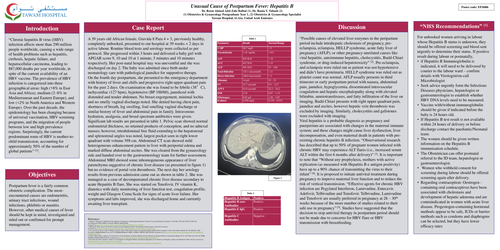
On the fourth day postpartum, she presented to the emergency department with history of fever and chills and progressive right upper quadrant pain for the past 2 days. On examination she was found to be febrile (38°C), tachycardiac (127 bpm), hypotensive (BP 100/60), jaundiced with distended and tender abdomen. No breast engorgement, minimal lochia and no smelly vaginal discharge noted. She denied having chest pain, shortness of breath, leg swelling, foul smelling vaginal discharge or similar history of fever and abdominal pain in family. Intravenous hydration, analgesia, and broad spectrum antibiotics were given. Significant lab results are presented in table 1. Pelvic scan showed normal endometrial thickness, no retained products of conception, and no adnexal masses; however, intrabdominal free fluid extending to the hepatorenal and splenorenal angles was noted, largest pocket seen in right lower quadrant with volume 398 cm. Abdominal CT scan showed mild heterogeneous enhancement pattern in liver with periportal edema and marked diffuse abdominal ascites. She was cleared from the gynaecology side and handed over to the gastroenterology team for further assessment. Abdominal MRI showed some inhomogeneous appearance of liver parenchyma suggestive of chronic liver disease (as presented in figure 1) but no evidence of portal vein thrombosis. The next day her serology results from previous admission came out as shown in table 2. She was managed as a case of decompensated chronic liver disease secondary to acute Hepatitis B flare. She was started on Tenofovir, IV vitamin K, diuretics with daily monitoring of liver function test, coagulation profile, weight and Glasgow Coma Scale for signs of acute liver failure. Her symptoms and labs improved, she was discharged home and currently awaiting liver transplant.
Discussuion:
“Possible causes of elevated liver enzymes in the peripartum period include intrahepatic cholestasis of pregnancy, pre-eclampsia, eclampsia, HELLP syndrome, acute fatty liver of pregnancy (AFLP); or other pregnancy-unrelated causes like viral hepatitis, autoimmune hepatitis, cholecystitis, Budd-Chiari syndrome, or drug-induced hepatotoxicity” [2]. Pre-eclampsia, and eclampsia were ruled out as patient was not hypertensive and didn’t have proteinuria. HELLP syndrome was ruled out as platelet count was normal. AFLP usually presents in third trimester or early postpartum period with nausea, abdominal pain, jaundice, hypoglycemia, disseminated intravascular coagulation and hepatic encephalopathy along with elevated bilirubin, amniotransferases, and fatty infiltration of the liver on imaging. Budd-Chiari presents with right upper quadrant pain, jaundice and ascites, however hepatic vein thrombosis was excluded by imaging. Similarly, cholecystitis and gallstones were excluded with imaging.
Viral hepatitis is a probable diagnosis as pregnancy and puerperium are associated with changes in the maternal immune system; and these changes might cause liver dysfunction, liver decompensation, and even maternal death in patients with pre-existing chronic hepatitis B infection. “Observational research has described that up to 50% of pregnant women infected with chronic HBV may experience ALT flares (i.e., increased serum ALT within the first 6 months after delivery)” [3]. It is important to note that “Without any prophylaxis, mothers with active replication (as measured with Hepatitis B e antigen positivity) have up to a 90% chance of transmitting the virus to their infant” [4]. It is proposed to initiate antiviral treatment during pregnancy to improve maternal liver function and to reduce the risk of vertical transmission. “Effective agents for chronic HBV infection are Pegylated Interferon, Lamivudine, Entecavir, Adefovir, Telbivudine and Tenofovir. Telbivudine, Lamivudine and Tenofovir are usually preferred in pregnancy at 28 – 30th weeks because of the more number of studies related to their safe use in pregnancy” [5]. Studies have suggested that the decision to stop antiviral therapy in postpartum period should not be made due to concerns for HBV flare or HBV transmission with breastfeeding.
“NHS Recommendations” [6]:
For unbooked women arriving in labour whose Hepatitis B status is unknown, they should be offered screening and blood sent urgently to determine their status. If positive result during labour or postnatally,
References:
1. Sirilert S, Tongsong T. Hepatitis B Virus Infection in Pregnancy: Immunological Response, Natural Course and Pregnancy Outcomes. J Clin Med. 2021 Jun 29;10(13):2926. doi: 10.3390/jcm10132926. PMID: 34210105; PMCID: PMC8267880.
Accessed via https://www.ncbi.nlm.nih.gov/pmc/articles/PMC8267880/#B1-jcm-10-02926
2. Rehman H. What caused elevated liver enzymes in this postpartum patient. The Journal of Family Practice. Mar 2014; Vol 63(3).
Accessed via https://cdn.mdedge.com/files/s3fs-public/Document/September-2017/JFP_06303_ArticleW1.pdf
3. Li L, Zou H, Xu M, Li S, Zhu Y, Zheng S, Duan Z, Chen Y. Risk factors related to postpartum hepatic inflammation in pregnant women with chronic hepatitis B. J Int Med Res. 2020 Nov;48(11):300060520966439. doi: 10.1177/0300060520966439. PMID: 33208011; PMCID: PMC7683929. Accessed via https://www.ncbi.nlm.nih.gov/pmc/articles/PMC7683929/#bibr15-0300060520966439
4. Jaffe A, Brown RS Jr. A Review of Antiviral Use for the Treatment of Chronic Hepatitis B Virus Infection in Pregnant Women. Gastroenterol Hepatol (N Y). 2017 Mar;13(3):154-163. PMID: 28539842; PMCID: PMC5439134. Accessed vita https://www.ncbi.nlm.nih.gov/pmc/articles/PMC5439134/#B10
5. Güven H, Arıcı MA, Aktürk G, Güner Ö. A Case Report of a Pregnant Woman with Chronic Hepatit B: Use of Tenofovir in Pregnancy J Basic Clin Health Sci 2020; 1:82-84. Accessed via https://dergipark.org.tr/tr/download/article-file/1460620
6. https://www.england.nhs.uk/north-west/wp-content/uploads/sites/48/2019/03/Hepatitis-B-in-Pregnancy-Guideline.pdf