1,830 posters, 67 videos, 75 audios, 29 topics, 22 sessions, 4,727 authors, 1,697 institutions
ePostersLive by SciGen Technologies S.A. All rights reserved.
RCOG World Congress 2023
June 12 - 14, 2023 | London, UK

EP.0484
PREGNANCY OUTCOMES AMONG WOMEN WITH SYSTEMIC LUPUS ERYTHEMATOSUS: A RETROSPECTIVE TEN-YEAR REVIEW
Poster Presenter
Authors
Affiliations
Part of Topic
High Risk Pregnancy
PREGNANCY OUTCOMES AMONG WOMEN WITH SYSTEMIC LUPUS ERYTHEMATOSUS: A RETROSPECTIVE TEN-YEAR REVIEW
SHIELA MAE D. PUTOL, MD, FPOGS; KRISTINE THERESE R. ELISES-MOLON, MD, FPOGS, FPSMFM, FPSUOG
University of the Philippines – Philippine General Hospital
Department of Obstetrics and Gynecology, Division of Maternal-Fetal Medicine
Background:
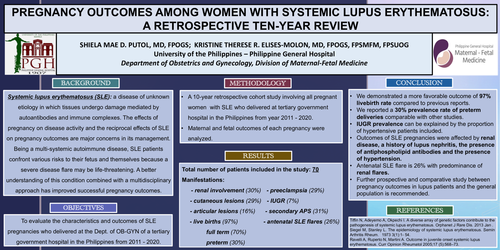
Systemic lupus erythematosus (SLE): a disease of unknown etiology in which tissues undergo damage mediated by autoantibodies and immune complexes. The effects of pregnancy on disease activity and the reciprocal effects of SLE on pregnancy outcomes are major concerns in its management. Being a multi-systemic autoimmune disease, SLE patients confront various risks to their fetus and themselves because a severe disease flare may be life-threatening. A better understanding of this condition combined with a multidisciplinary approach has improved successful pregnancy outcomes.
Objectives:
To evaluate the characteristics and outcomes of SLE pregnancies who delivered at the Dept. of OB-GYN of a tertiary government hospital in the Philippines from 2011 - 2020.
Methodology:
Results:
There were 70 SLE patients included in this study. The most common manifestations were renal involvement (30%), cutaneous lesions (29%) and articular lesions (16%). The prevalence of live births was 97% where 70% were full term and 30% were preterm. Preeclampsia developed in 29% of patients and IUGR was noted in 7% of patients. Secondary APS was diagnosed in 31% of cases. Twenty six percent of the patients developed SLE flares during pregnancy. Renal flares were the most frequent. Prior renal involvement was present in all cases with renal flares.
Conclusion:
Lupus patients are a high-risk pregnancy group. Our present study demonstrated a more favorable outcome of 97% live birth rate compared to previous report in the Philippines. We reported a 30% prevalence rate of preterm deliveries and this was comparable with other studies. The prevalence of IUGR in our cohort can be explained by the proportion of hypertensive patients included in our study. We have demonstrated that adverse maternal and fetal outcomes of SLE pregnancies were affected by renal disease or a history of lupus nephritis, the presence of antiphospholipid antibodies and the presence of hypertension. Our reported antenatal SLE flare is 26% with predominance of renal flares. However, further prospective cohort study and comparative study between pregnancy outcomes in lupus patients and the general population is recommended.