1,830 posters, 67 videos, 75 audios, 29 topics, 22 sessions, 4,727 authors, 1,697 institutions
ePostersLive by SciGen Technologies S.A. All rights reserved.
RCOG World Congress 2023
June 12 - 14, 2023 | London, UK

EP.0482
For pregnant women with previous OASI, are endoanal ultrasonography and manometry useful?
Poster Presenter
Part of Topic
Hot Topics (Emerging research/issues) in Obstetrics
For pregnant women with previous OASI, are endoanal ultrasonography and manometry useful?
Dr Phoebe Stocker, Dr Sophia NE Webster, Grace Fairlamb
Background
The UK incidence for obstetric anal sphincter injury (OASI) is 3 per 100 vaginal births. Functional effects may include flatus incontinence, faecal urgency and anal incontinence. RCOG recommends assessment in subsequent pregnancy of anal sphincter using endoanal ultrasonography (US) and anorectal manometry, and women with ongoing symptoms or abnormal results should be counselled for elective Caesarean section to reduce the risk of worsening sphincter function.(1)
Objective
To identify the symptoms experienced by women with previous OASI, evaluate the results of endoanal US and anorectal manometry in subsequent pregnancy and assess the use of these investigations in choices about birth.
Method
Retrospective audit of endoanal ultrasonography and manometry reports, MDT and antenatal clinic documentation and patient feedback forms of 22 patients who received the studies at the RVI, February 2021 to May 2022.
Results
Tears: Of the 22 cases of previous OASI, 17 were third degree, 2 were fourth degree and 3 were of unknown grade.
Symptoms: At the time of the study, 45% of patients were symptomatic of anorectal symptoms, mainly ‘minor’ symptoms of flatus incontinence, occasional soiling and/or faecal urgency.
Investigation results: 12/22 (55%) patients had normal results for both investigations. 10/22 (45%) had significant defects on ultrasound and/or manometry and this included 6/10 (60%) of symptomatic patients and 5/12 (42%) of asymptomatic patients.
Mode of birth (MOB): Nineteen patients had delivered at the time of data analysis, of which 17/19 (89%) had their planned MOB. All eight patients who opted for planned Caesarean birth had one. 9/19 (47%) patients delivered vaginally of which 8/9 (89%) sustained second-degree tears and one had an episiotomy. There were no further occurrences of OASI.
Outcomes: 8/19 (42%) of the patients who gave birth had abnormal anorectal study results. Although Caesarean birth was recommended in all cases, 3/8 (38%) opted to trial vaginal birth. Two of these patients had emergency Caesarean birth for reasons unrelated to their previous OASI and one delivered vaginally.
Patient feedback: Of the five patients who filled out the feedback form, all stated they found the investigations helpful in planning MOB, and all were satisfied with their chosen MOB following delivery.
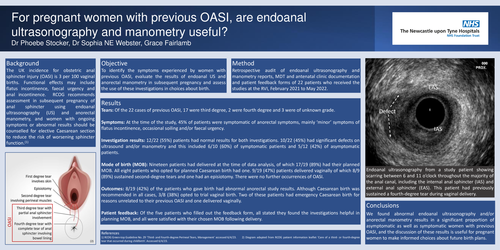
[Image caption]
Endoanal ultrasonography from a study patient showing scarring between 6 and 11 o’clock throughout the majority of the anal canal, including the internal anal sphincter (IAS) and external anal sphincter (EAS). This patient had previously sustained a fourth-degree tear during vaginal delivery.
Conclusions
We found abnormal endoanal ultrasonography and/or anorectal manometry results in a significant proportion of asymptomatic as well as symptomatic women with previous OASI, and the discussion of these results is useful for pregnant women to make informed choices about future birth plans.
References
1) RCOG Green-top Guideline No. 29 ‘Third- and Fourth-degree Perineal Tears, Management’ accessed 6/4/23.
2) Diagram adapted from RCOG patient information leaflet ‘Care of a third- or fourth-degree tear that occurred during childbirth’. Accessed 6/4/23.