1,830 posters, 67 videos, 75 audios, 29 topics, 22 sessions, 4,727 authors, 1,697 institutions
ePostersLive by SciGen Technologies S.A. All rights reserved.
RCOG World Congress 2023
June 12 - 14, 2023 | London, UK

EP.0471
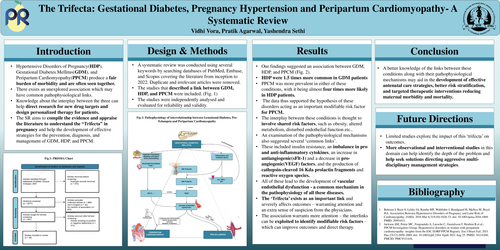
The Trifecta: Gestational Diabetes, Pregnancy Hypertension and Peripartum Cardiomyopathy- A Systematic Review
Poster Presenter
Part of Topic
High Risk Pregnancy
Audio
The Trifecta: Gestational Diabetes, Pregnancy Hypertension and Peripartum Cardiomyopathy- A Systematic Review
Vidhi Vora, Pratik Agarwal, Yashendra Sethi
Introduction
•Hypertensive Disorders of Pregnancy(HDP), Gestational Diabetes Mellitus(GDM), and Peripartum Cardiomyopathy(PPCM) produce a fair burden of morbidity and are often seen together.
•There exists an unexplored association which may have common pathophysiological links.
•Knowledge about the interplay between the three can help direct research for new drug targets and design personalized therapy for patients.
•The SR aims to compile the evidence and appraise the literature to understand the “Trifecta” in pregnancy and help the development of effective strategies for the prevention, diagnosis, and management of GDM, HDP, and PPCM.
Design & Methods
•A systematic review was conducted using several keywords by searching databases of PubMed, Embase, and Scopus covering the literature from inception to 2022. Duplicate and irrelevant articles were removed.
•The studies that described a link between GDM, HDP, and PPCM were included. (Fig. 1)
•The studies were independently analysed and evaluated for reliability and validity.
Results
•Our findings suggested an association between GDM, HDP, and PPCM (Fig. 2).
•HDP were 1.5 times more common in GDM patients
•PPCM was more prevalent in either of these conditions, with it being almost four times more likely in HDP patients.
• The data thus supported the hypothesis of these disorders acting as an important modifiable risk factor for PPCM.
•The interplay between these conditions is thought to involve shared risk factors, such as obesity, altered metabolism, disturbed endothelial function etc..
•An examination of the pathophysiological mechanisms also suggested several ‘common links’.
•These included insulin resistance, an imbalance in pro and anti-inflammatory cytokines, an increase in antiangiogenic(sFlt-1) and a decrease in pro-angiogenic(VEGF) factors, and the production of cathepsin-cleaved 16 Kda prolactin fragments and reactive oxygen species.
•All of these lead to the development of vascular endothelial dysfunction - a common mechanism in the pathophysiology of all these diseases.
•The ‘Trifecta’ exists as an important link and severely affects outcomes – warranting attention and an extra sense of suspicion from the physicians.
•The association warrants more attention – the interlinks can be exploited to identify modifiable risk factors – which can improve outcomes and direct therapy.
Conclusion
•A better knowledge of the links between these conditions along with their pathophysiological mechanisms may aid in the development of effective antenatal care strategies, better risk stratification, and targeted therapeutic interventions reducing maternal morbidity and mortality.
Future Directions
•Limited studies explore the impact of this ‘trifecta’ on outcomes.
•More observational and interventional studies in this domain can help identify the depth of the problem and help seek solutions directing aggressive multi-disciplinary management strategies.
Bibliography
1.Behrens I, Basit S, Lykke JA, Ranthe MF, Wohlfahrt J, Bundgaard H, Melbye M, Boyd HA. Association Between Hypertensive Disorders of Pregnancy and Later Risk of Cardiomyopathy. JAMA. 2016 Mar 8;315(10):1026-33. doi: 10.1001/jama.2016.1869. PMID: 26954411.
2.Jackson AM, Petrie MC, Frogoudaki A, Laroche C, Gustafsson F, Ibrahim B et al.; PPCM Investigators Group. Hypertensive disorders in women with peripartum cardiomyopathy: insights from the ESC EORP PPCM Registry. Eur J Heart Fail. 2021 Dec;23(12):2058-2069. doi: 10.1002/ejhf.2264. Epub 2021 Aug 25. PMID: 34114268; PMCID: PMC9311416.