1,830 posters, 67 videos, 75 audios, 29 topics, 22 sessions, 4,727 authors, 1,697 institutions
ePostersLive by SciGen Technologies S.A. All rights reserved.
RCOG World Congress 2023
June 12 - 14, 2023 | London, UK

EP.0466
Emergency management of unprepared patients with placenta accrete spectrum. A real dilemma
Poster Presenter
Authors
Affiliations
Part of Topic
High Risk Pregnancy
Video
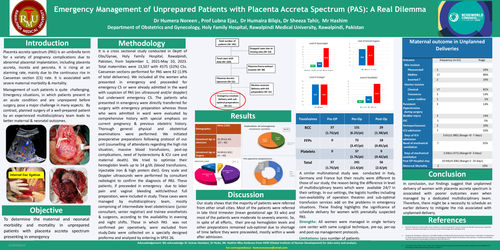
Emergency management of unprepared patients with Placenta Accreta Spectrum (PAS). A real dilemma
Authors: Dr Humera Noreen , Prof Lubna Ejaz Dr Humaira Bilqis Dr Sheeza Tahir, Mr Hashim
Department of Obstetric and Gynecology, Holy Family Hospital affiliated with Rawalpindi Medical University, Rawalpindi, Pakistan
Introduction
Placenta accreta spectrum (PAS) is an umbrella term for a variety of pregnancy complications due to abnormal placental implantation, including placenta accreta, increta and percreta. It is rising at an alarming rate, mainly due to the continuous rise in Caesarean section (CS) rate. It is associated with severe maternal morbidity & mortality.
Management of such patients is quite challenging. Emergency situations, in which patients present in an acute condition and are unprepared before surgery, pose a major challenge in many aspects. By contrast, planned surgery of a well-prepared patient by an experienced multidisciplinary team leads to better maternal & neonatal outcomes.
Objective
To determine the maternal and neonatal morbidity and mortality in unprepared patients with placenta accreta spectrum presenting in emergency
Materials and methods
It is a cross sectional study conducted in Deptt of Obs/Gynae, Holy Family Hospital, Rawalpindi, Pakistan, from September 1, 2021-May 10, 2023. Total maternities were 13,507 with 4375 (32%) CSs. Caesarean sections performed for PAS were 82 (1.9% of total deliveries). We included all the women who presented in emergency and proceeded for emergency CS or were already admitted in the ward with suspicion of PAS (on ultrasound and/or doppler) but underwent emergency CS. The patients who presented in emergency were directly transferred for surgery with emergency preparation whereas those who were admitted in ward were evaluated by comprehensive history with special emphasis on current pregnancy & previous obstetric history. Thorough general physical and obstetrical examinations were performed. We initiated preoperative preparations following protocol of our unit (counselling of attendants regarding the high risk situation, massive blood transfusions, post-op complications, need of hysterectomy & ICU care and maternal death). We tried to optimize their hemoglobin levels up to 14 g/dL (blood transfusions, injectable iron & high protein diet). Grey scale and Doppler ultrasounds were performed by consultant radiologist to confirm the diagnosis of PAS. These patients, if proceeded in emergency due to labor pain and vaginal bleeding with/without full preparation, were included in study. These cases were managed by multidisciplinary team, mostly comprising of intermediate level obstetricians (junior consultant, senior registrar) and trainee anesthetists & surgeons, according to the availability in evening and night shifts. Those in which PAS was not confirmed per operatively, were excluded from study.Data were collected on a specially designed proforma and analyzed by entering in SPSS 26.
Discussion
Our study shows that the majority of patients were referred from other small cities. Most of the patients were referred in late third trimester (mean gestational age 33 wks) and most of the patients were moderate to severely anemic. So, in spite of all efforts, their pre-op hemoglobin levels and other preparations remained sub-optimal due to shortage of time before they were proceeded, mostly within a week after admission.
A similar multinational study was conducted in Italy, Germany and France but their results were different to those of our study, the reason being the difference in level of multidisciplinary teams which were available 24/7 in their settings. In our settings, the logistic hurdles including non-availability of operation theatres and sub-optimal transfusion services add on the problems in emergency situations. These finding highlights the significance of schedule delivery for women with prenatally suspected PAS.
Strengths: All women were managed in single tertiary care center with same surgical technique, pre-op, per-op and post-op management protocols.
Limitations: Less number of patients
Conclusion
In conclusion, our findings suggest that unplanned delivery of women with placenta accreta spectrum is associated with poorer outcomes even when managed by a dedicated multidisciplinary team. Therefore, there might be a necessity to schedule an earlier delivery to mitigate the risk associated with unplanned delivery.
Conflict of interest
There is no conflict of interest
References
Acknowledgment
We acknowledge Dr Usman Hamdani, Dr Huda, Mr. Hashim Miss Ambreen from GIHD (Global Institute of Human Development) for data entry and analysis.
For correspondence: humeranoreen@ymail.com