1,830 posters, 67 videos, 75 audios, 29 topics, 22 sessions, 4,727 authors, 1,697 institutions
ePostersLive by SciGen Technologies S.A. All rights reserved.
RCOG World Congress 2023
June 12 - 14, 2023 | London, UK

EP.0461
Breech Versus Cephalic Elective Caesarean Deliveries – A Comparison of Immediate Neonatal Outcomes
Poster Presenter
Authors
Affiliations
Part of Topic
Labour Ward Management
Breech Versus Cephalic Elective Caesarean Deliveries
A Comparison of Immediate Neonatal Outcomes
Genevieve Kan, Jolyon Ford
1. Women’s Health Unit, Peninsula Health, Frankston, Victoria, Australia
Objective
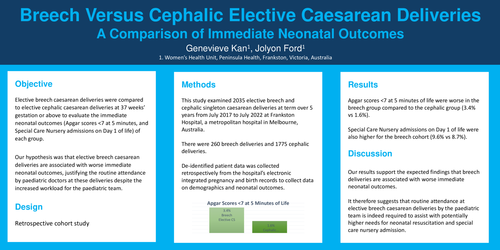
Elective breech caesarean deliveries were compared to elective cephalic caesarean deliveries at 37 weeks’ gestation or above to evaluate the immediate neonatal outcomes (Apgar scores <7 at 5 minutes, and Special Care Nursery admissions on Day 1 of life) of each group.
Our hypothesis was that elective breech caesarean deliveries are associated with worse immediate neonatal outcomes, justifying the routine attendance by paediatric doctors at these deliveries despite the increased workload for the paediatric team.
Design
Retrospective cohort study
Methods
This study examined 2035 elective breech and cephalic singleton caesarean deliveries at term over 5 years from July 2017 to July 2022 at Frankston Hospital, a metropolitan hospital in Melbourne, Australia.
There were 260 breech deliveries and 1775 cephalic deliveries.
De-identified patient data was collected retrospectively from the hospital’s electronic integrated pregnancy and birth records to collect data on demographics and neonatal outcomes.
Results
Apgar scores <7 at 5 minutes of life were worse in the breech group compared to the cephalic group (3.4% vs 1.6%).
Special Care Nursery admissions on Day 1 of life were also higher for the breech cohort (9.6% vs 8.7%).
Discussion
Our results support the expected findings that breech deliveries are associated with worse immediate neonatal outcomes.
It therefore suggests that routine attendance at elective breech caesarean deliveries by the paediatric team is indeed required to assist with potentially higher needs for neonatal resuscitation and special care nursery admission.