1,830 posters, 67 videos, 75 audios, 29 topics, 22 sessions, 4,727 authors, 1,697 institutions
ePostersLive by SciGen Technologies S.A. All rights reserved.
RCOG World Congress 2023
June 12 - 14, 2023 | London, UK

EP.0446
Impact of covid19 pandemic on medical students education, A multicenter quantitative study
Poster Presenter
Part of Topic
Pandemic and impact of Covid/Infectious Diseases
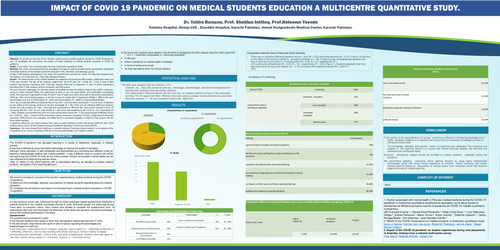
Impact of covid 19 pandemic on medical students education A multi center quantitative study.
Tahira Ramzan;Shahina Ishtiaq;Haleema Yasmin
Objective: To provide an overview of the situation experienced by medical students during the COVID-19 pandemic, and To investigate the perceptions and impact of online teaching on medical students education in COVID 19 pandemic.
Design: A six months cross sectional online learning, multicenter quantitative study .
Methods: This study was conducted by the investigators through an online and paper based questionnaire distributed to medical students of two medical universities through E mails, face book and whatsapp groups.
A total of 500 students participated in this study. The questionnaire consisted of 5 parts. The data were analyzed with the Statistic-a 13.3 (Stat Soft, Inc., Tulsa, OK) statistical software.
Results: The characteristics of the medical students are explained and among the 500 students, (29%) were males and (71%) were females. The age of the students ranged from 19 to 24 years (M = 22.66, SD = 2.15). A total of 60% students had previous experience with e-learning, whereas 40% had no experience. A total of (56%) respondents described their IT skills as good, (42%) as moderate, and (2%) as poor.
The most frequent advantages of e-learning chosen by respondents were the ability to stay at home (69%), continuous access to online materials (69%), the opportunity to learn at your own pace (64%), and comfortable surroundings (54%). The majority of respondents in their 4th and 5th year of study more often chose lack of interactions with patients (70%) (p< .001) and technical problems in the first 3 years of studies with IT equipment (54%)(p = .003) as the main disadvantages and lack of self-discipline (P < .001), and social isolation (P = .008) as e-learning disadvantages.
There was no statistical difference between face-to face (M = 3.23) and online learning (M = 3.27) in terms of opinions on the ability of the learning method to increase knowledge (P = .46). There was no statistical difference between female and male students (p =.46) . E-learning was considered less effective than face-to-face learning in terms of increasing skills (M = 2.03, M = 4.3, respectively) (P < .001) and social competences (M = 2.03, M = 4.2, respectively) (P < .001). Students assessed that they were less active during online classes (M = 2.72) compared with traditional classes (M = 3.82) (P < .001) . A total of (73%) respondents rated e-learning as enjoyable. Of these, (15%) found it extremely enjoyable, (29%) found it very enjoyable, and (28%) found it somewhat enjoyable. A total of (27%) students did not enjoy online learning.
A significant difference was found between time spent on online platforms before and during COVID-19, with 7.35% students before versus 23.56% students during the pandemic spending >15 hours per week (p<0.05).
Conclusion: This study showed that e-learning is a valuable method of teaching medical students. In the opinion of the respondents in our survey, e-learning is effective in increasing knowledge and is highly accepted.