1,830 posters, 67 videos, 75 audios, 29 topics, 22 sessions, 4,727 authors, 1,697 institutions
ePostersLive by SciGen Technologies S.A. All rights reserved.
RCOG World Congress 2023
June 12 - 14, 2023 | London, UK

EP.0438
reference ranges for anti-mülerian hormone in Chinese women from 20-49 years
Poster Presenter
Authors
Hu Linli, Yunshan Zhang, Qiongfang Wu, Xiaoyan Liang, Xiaohong Wang, Cunying Pu, Yingpu Sun, Xue Wu
Affiliations
Center for Reproductive Medicine, The First Affiliated Hospital of Zhengzhou University, Center for Reproductive Medicine, Tianjin Central Hospital of Gynecology Obstetrics, Center for Reproductive Medicine, Jiangxi Maternal and Child Health Hospital, Reproductive Medicine Center, The Sixth Affiliated Hospital of Sun Yat-sen University, Department of Obstetrics and Gynecology, Tangdu Hospital, Air Force Medical University, Medical and Scientific Affairs, Roche Diagnostics (Shanghai) Co., Ltd.
Part of Topic
Reproductive Medicine/Assisted Reproduction
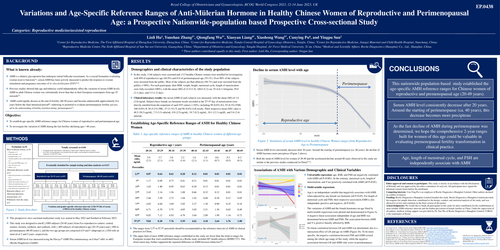
Variations and Age-Specific Reference Ranges of Anti-Mülerian Hormone in Healthy Chinese Women of Reproductive and Perimenopausal Age: a Prospective Nationwide-population based Prospective Cross-sectional Study
Categories: Reproductive medicine/assisted reproduction
Linli Hu1, Yunshan Zhang2*, Qiongfang Wu3*, Xiaoyan Liang4*, Xiaohong Wang5*, Cunying Pu6, and Yingpu Sun1
1 Center for Reproductive Medicine, The First Affiliated Hospital of Zhengzhou University, Zhengzhou, China;
2 Center for Reproductive Medicine, Tianjin Central Hospital of Gynecology Obstetrics, Tianjin, China;
3 Center for Reproductive Medicine, Jiangxi Maternal and Child Health Hospital, Nanchang, China,;
4 Reproductive Medicine Center, The Sixth Affiliated Hospital of Sun Yat-sen University, Guangzhou, China;
5 Department of Obstetrics and Gynecology, Tangdu Hospital, Air Force Medical University, Xi’an, China;
6 Medical and Scientific Affairs, Roche Diagnostics (Shanghai) Co., Ltd., Shanghai, China
* These authors contributed equally to this study;
First author: Linli Hu, Corresponding author: Yingpu Sun
BACKGROUND
What is known already:
1. AMH is a dimeric glycoprotein that undergoes initial follicular recruitment. As a crucial biomarker evaluating
ovarian reserve functions [1], serum AMH has been actively measured to predict the response to ovarian
stimulation and pregnancy outcomes of in vitro fertilization (IVF)[2-4].
2. Previous studies showed that age and ethnicity could independently affect the variation of serum AMH levels:
AMH in adult Chinese women was substantially lower than that in their European counterparts from age 25
onwards [5].
3. AMH could rapidly decrees at the end of fertility (40 50 years) and become undetectable approximately five
years before the final menstrual period [6], endowing its potential to evaluate perimenopause fertility and also
aid in the understanding of fertility transition during perimenopause [7].
Objective:
1. To establish age specific AMH reference ranges for Chinese women of r eproductive and p erimenopausal age.
2. To investigate the variation of AMH during the fast fertility declining ages >40 years.
METHODS
1. This prospective cross-sectional multicenter study was started in May 2022 and finished in February 2023.
2. This study was designed to enroll ≥1080 subjects (20-49 years) from five reproductive centers: central, eastern, western, northern, and southern, with ≥ 480 subjects of reproductive age (20-39 years) and ≥ 600 in perimenopause (40-49 years) ), and the two age groups are composed of 4 and 5 subgroups (n ≥120) with an interval of 2 and 5 years, respectively.