1,830 posters, 67 videos, 75 audios, 29 topics, 22 sessions, 4,727 authors, 1,697 institutions
ePostersLive by SciGen Technologies S.A. All rights reserved.
RCOG World Congress 2023
June 12 - 14, 2023 | London, UK

EP.0437
ASSOCIATION OF MATERNAL SERUM HOMOCYSTEINE LEVEL WITH THE SEVERITY OF PREECLAMPSIA
Poster Presenter
Authors
Affiliations
Part of Topic
Maternal Medicine
A CASE CONTROL STUDY ON THE ASSOCIATION OF MATERNAL SERUM HOMOCYSTEINE LEVEL WITH THE SEVERITY
OF PREECLAMPSIA BY DR. MOULI NANDI MBBS, MD, MRCOG
INTRODUCTION
AIM OF RESEARCH
METHADOLOGY RESULTS
DISCUSSION
CONCLUSIONS
1. To estimate plasma levels of homocysteine in pregnant women with
normal blood pressure, with different grades of preeclampsia and
eclampsia.
2. To find out whether any significant change in the level of
homocysteine
exists among the groups.
3. To find out whether there is any association between level of
homocysteine and the severity of preeclampsia.
• Hypertensive disorders complicate 5 to 10 percent of all pregnancies.
• Levels of maternal serum homocysteine normally decrease with
gestation
• The foetus may use homocysteine to lower levels throughout pregnancy.
• Folic acid supplementation increased red blood cell folate and lowered
homocysteine.
• MTHFR and CBS gene mutations cause hyperhomocysteinemia.
STUDY POPULATION: 200 women were recruited in the study in which
50 were normotensive, 50 cases had non severe preeclampsia, 50
cases had severe preeclampsia and 50 cases had eclampsia.
CRITERIA:
INCLUSION EXCLUSION
Chronic hypertension, women on
antifolate
drugs, abruptio placentae, smokers,
tobacco chewers, chronic kidney and
cardiovascular diseases.
Cases: Pregnant women in the
gestational age of
28 weeks-42weeks which were
further divided into three groups;
women
with non severe preeclampsia, severe
preeclampsia and with eclampsia
.Controls: Pregnant women who
remain normotensive throughout
pregnancy
and delivery.
GROUP 1: 50 pregnant women who remain normotensive throughout
pregnancy and delivery which serve as controls.
GROUP 2: 50 pregnant women, GA: 28-42 weeks with non
severepreeclampsia, BP >/= 140/90 mm Hg(but less than 160/110mm
Hg)for the first time during pregnancy in 2 or more readings 4 hr apart with
proteinuria & gt;/= 300mg/24hr or protein dipstick 1+(30mg/dl) or more in
random urine sample.
GROUP 3: 50 pregnant women, GA: 28-42 weeks with severe preeclampsia
ie, BP>/=160/110mm Hg, protein excretion >5gm /24hr /oliguria
(<400ml/24hrs) / platelet count <1,00,000/mm 3 / HELLP syndrome/
premonitory symptoms/pulmonary edema.
GROUP 4: 50 pregnant women, GA: 28-42 weeks with eclampsia;
preeclampsia complicated by convulsion.
All patients will have their Sr homocysteine assessed at admission. After the
diagnosis of pre-eclampsia or eclampsia, a 5ml venous blood sample will be
taken from the antecubital vein regardless of fasting status to assess serum
homocysteine levels in cases and controls.
Samples will be centrifuged for 5-7 minutes at 3000 rpm. Clear serum is
transfused in a plastic bottle and refrigerated until analysis. 2-8°C will store
samples (stable upto 14 days when refrigerated). Commercial ELISA kits
measures Homocysteic acid levels using a double antibody sandwich enzyme
linked immunosorbent one-step method test. In precoated enzyme wells, add
standard, test sample, and HRP-labelled Homocysteic acid antibodies..
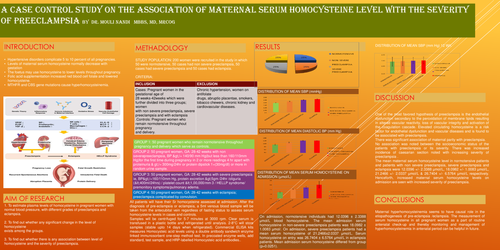
DISTRIBUTION OF MEAN SBP (mmHg)
DISTRIBUTION OF MEAN DIASTOLIC BP (mm Hg)
DISTRIBUTION OF MEAN SERUM HOMOCYSTEINE ON
ADMISSION (μmol/L)
On admission, normotensive individuals had 12.0396 ± 2.3388
μmol/L blood homocysteine. The mean admission serum
homocysteine in non-severe preeclampsia patients was 18.0982 ±
1.0083 μmol/. On admission, severe preeclampsia patients had a
mean serum homocysteine of 21.2466±2.0337 μmol/L. Serum
homocysteine on entry was 26.7404 ± 6.5764 μmol/L in eclampsia
patients. Mean admission serum homocysteine differed from group
(p=0.0251).
DISTRIBUTION OF MEAN SBP (mm Hg) 12 WK
Maternal hyperhomocysteinemia seems to have causal role in the
etiopathogenesis of pre-eclampsia /eclampsia. The measurement of
serum homocysteine in all pregnant women as a part of routine
antenatal check-up and thereby monitoring and management of
hyperhomocysteinemia in antenatal period can be helpful in future.
One of the most favored hypothesis of preeclampsia is the endothelial
dysfunction secondary to the peroxidation of membrane lipids resulting
in altered vascular reactivity, loss of vascular integrity and activation of
the coagulation cascade. Elevated circulating homocysteine is a risk
factor for endothelial dysfunction and vascular diseases and is found to
be associated with preeclampsia.
There was significant association of maternal parity with preeclampsia.
No association was noted between the socioeconomic status of the
patients with preeclampsia or its severity. There was increased
incidence of caesarian section noted with increasing severity of
preeclampsia .
The mean maternal serum homocysteine level in normotensive patients
and patients with non severe preeclampsia, severe preeclampsia and
eclampsia were 12.0396 +/- 2.3388 μmol/L, 18.0982 +/- 1.0083 μmol/L,
21.2466 +/- 2.0337 μmol/L & 26.7404 +/- 6.5764 μmol/L respectively.
Henceforth, increased maternal serum homocysteine levels on
admission are seen with increased severity of preeclampsia.