1,830 posters, 67 videos, 75 audios, 29 topics, 22 sessions, 4,727 authors, 1,697 institutions
ePostersLive by SciGen Technologies S.A. All rights reserved.
RCOG World Congress 2023
June 12 - 14, 2023 | London, UK

EP.0434
The etiological profile of stillbirth and its trend over 10 years
Poster Presenter
Authors
vaidyanathan Gowri, Adahm Al Rahbi, Fatma Al Hoqani, Suha A S Al Ajmi
Affiliations
Part of Topic
Maternal Medicine
The Etiological Profile of Stillbirth and its Changing Trend in a 10-year Period at Sultan Qaboos University Hospital
Dr. Fatma Ali AL Hoqani1, Dr. Adham Amer Al Rahbi2,, Dr Suha AL Ajmi 3 Dr. Gowri Vaidyanathan4
Stillbirth or intrauterine fetal death defined as fetal death occurred after 24 weeks of gestation or fetal birth weight of 500 grams or more. (1)
Stillbirth rate (SBR) defined as the number of stillbirths per 1000 births (live and stillbirths).
According to World Health Organization (WHO) data and statistics, it is estimated that 2.6 million stillbirths occurred annually worldwide with the rate of 18.4 per 1000 in 2015. (2)
Latest reported stillbirth rate in Oman is 8 stillbirth per 1000 delivery in 2018. (3)
This study aimed to determine the etiology of stillbirth and its changing trend in a 10-year period (from January 2010 to December 2019) at Sultan Qaboos University Hospital (SQUH), to provide better clinical knowledge and to help formulate strategies to reduce preventable fetal loss in the country.
Study was a retrospective descriptive cohort study. Participants were all stillbirth born at SQUH in study period from January 2010 to December 2019. Participant’s medical record number obtained from delivery book registry at department of obstetrics and gynecology at SQUH. Details of each case of stillbirth were obtained by reviewing medical record of each case.
Data analysis was performed using the Statistical Package for the Social Sciences (SPSS version 22)
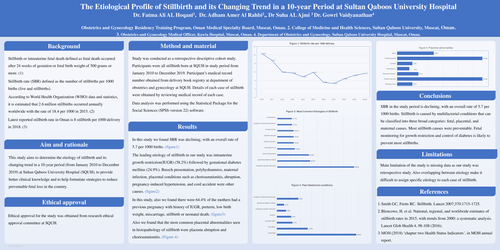
In this study we found SBR was declining, with an overall rate of 5.7 per 1000 births. (figure1)
The leading etiology of stillbirth in our study was intrauterine growth restriction(IUGR) (58.2%) followed by gestational diabetes mellitus (24.9%). Breech presentation, polyhydramnios, maternal infection, placental conditions such as chorioamnionitis, abruption, pregnancy-induced hypertension, and cord accident were other causes. (figure2)
In this study, also we found there were 64.4% of the mothers had a previous pregnancy with history of IUGR, preterm, low birth weight, miscarriage, stillbirth or neonatal death. (figure3)
SBR in the study period is declining, with an overall rate of 5.7 per 1000 births. Stillbirth is caused by multifactorial conditions that can be classified into three broad categories: fetal, placental, and maternal causes. Most stillbirth causes were preventable. Fetal monitoring for growth restriction and control of diabetes is likely to prevent most stillbirths.