1,830 posters, 67 videos, 75 audios, 29 topics, 22 sessions, 4,727 authors, 1,697 institutions
ePostersLive by SciGen Technologies S.A. All rights reserved.
RCOG World Congress 2023
June 12 - 14, 2023 | London, UK

EP.0432
Reducing The Rate Of Primary Major Obstetric Haemorrhage Using A Care Bundle
Poster Presenter
Authors
Nikita Patel, Katherine Barrett, Sunn Yap, Wallace Hong, Joanna Allam, Millicent Nwandison
Affiliations
Part of Topic
Labour Ward Management
Reducing The Rate Of Primary MOH Using A Care Bundle
Objective:
To evaluate the effectiveness of the MOH care bundle introduced to Chelsea and Westminster Hospital in 2018.
Design:
A retrospective review of MOH cases was conducted from 2017 to 2022.
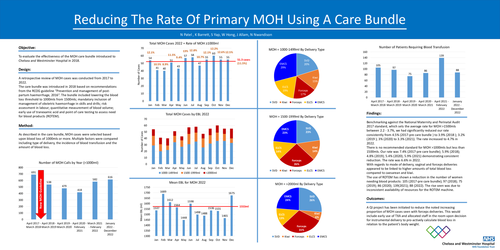
The care bundle was introduced in 2018 based on recommendations from the RCOG guideline “Prevention and management of post-partum haemorrhage, 2016”. The bundle included lowering the blood loss threshold to 1000mls from 1500mls; mandatory inclusion of management of obstetric haemorrhage in skills and drills; risk assessment in labour; quantitative measurement of blood volume; early use of tranexamic acid and point of care testing to assess need for blood products (ROTEM).
Method:
As described in the care bundle, MOH cases were selected based upon blood loss of 1000mls or more. Multiple factors were compared including type of delivery, the incidence of blood transfusion and the amount of blood loss.
Findings:
Benchmarking against the National Maternity and Perinatal Audit 2017 standard, which sets the average rate for MOH >1500mls between 2.2 - 3.7%, we had significantly reduced our rate consistently from 4.5% (2017-pre care bundle ) to 3.9% (2018 ); 3.2% (2019 ); 3% (2020) to 3.3% (2021). The rate increased to 4.7% in 2022.
There is no recommended standard for MOH >1000mls but less than 1500mls. Our rate was 7.4% (2017-pre care bundle); 5.9% (2018); 4.8% (2019); 5.4% (2020); 5.9% (2021) demonstrating consistent reduction. The rate was 6.6% in 2022.
With regards to mode of delivery, vaginal and forceps deliveries appeared to be linked to higher amounts of total blood loss compared to caesarean and kiwi.
The use of ROTEM has shown a reduction in the number of women needing blood products: 105 (2017-pre care bundle); 97 (2018); 75 (2019); 86 (2020); 139(2021); 88 (2022). The rise seen was due to inconsistent availability of resources for the ROTEM machine.
Outcomes:
A QI project has been initiated to reduce the noted increasing proportion of MOH cases seen with forceps deliveries. This would include early use of TXA and allocated staff in the room upon decision for instrumental delivery to pro-actively calculate blood loss in relation to the patient’s body weight.