1,830 posters, 67 videos, 75 audios, 29 topics, 22 sessions, 4,727 authors, 1,697 institutions
ePostersLive by SciGen Technologies S.A. All rights reserved.
RCOG World Congress 2023
June 12 - 14, 2023 | London, UK

EP.0428
Maternal and fetal outcomes of twin pregnancies: a retrospective cohort study
Poster Presenter
Authors
Affiliations
Part of Topic
Maternal Medicine
Maternal and fetal outcomes of twin pregnancies: a retrospective cohort study
Ana Sofia Carneiro1, Rosa Sardinha1, Pedro Oliveira1 -1- Hospital Senhora da Oliveira, Guimarães, Portugal
Introduction
Twin pregnancies are an uncommon condition that can occur with multiple complications for the mother and fetus.
The aim of this study was to access maternal and fetal outcomes, in twin pregnancy, in the last 7 years, as a differentiated perinatal hospital.
Methods
Retrospective single-center study of twin pregnancies followed at our obstetrics department, between 2015 and 2022. The study included 313 women. Data was collected from electronic patient records and retrospectively reviewed.
Were assessed maternal and fetal outcomes.
The statistical analyses were performed using IBM®SPSS®Statistics29.
Results
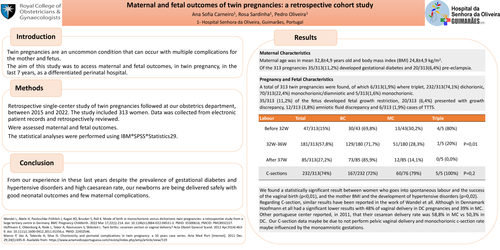
Maternal Characteristics: Maternal age was in mean 32,8±4,9 years old and body mass index (BMI) 24,8±4,9 kg/m2. Of the 313 pregnancies 35/313(11,2%) developed gestational diabetes and 20/313(6,4%) pre-eclampsia.
Pregnancy and Fetal Characteristics: A total of 313 twin pregnancies were found, of which 6/313(1,9%) where triplet, 232/313(74,1%) dichorionic, 70/313(22,4%) monochorionic/diamniotic and 5/313(1,6%) monochorionic. 35/313 (11,2%) of the fetus developed fetal growth restriction, 20/313 (6,4%) presented with growth discrepancy, 12/313 (3,8%) amniotic fluid discrepancy and 6/313 (1,9%) cases of TTTS.
We found a statistically significant result between women who goes into spontaneous labour and the success of the vaginal birth (p<0,01), and the mother BMI and the development of hypertensive disorders (p=0,02).
Regarding C-section, similar results have been reported in the work of Wandel et all. Although in Dennamark Hoofmann et all had a significant lower results with 48% of vaginal delivery in DC pregnancies and 39% in MC.
Other portuguese center reported, in 2011, that their cesarean delivery rate was 58,8% in MC vs 50,3% in DC. Our C-section data maybe be due to not perform pelvic vaginal delivery and monochorionic c-section rate maybe influenced by the monoamniotic gestations.
Conclusion
From our experience in these last years despite the prevalence of gestational diabetes and hypertensive disorders and high caesarean rate, our newborns are being delivered safely with good neonatal outcomes and few maternal complications.