1,830 posters, 67 videos, 75 audios, 29 topics, 22 sessions, 4,727 authors, 1,697 institutions
ePostersLive by SciGen Technologies S.A. All rights reserved.
RCOG World Congress 2023
June 12 - 14, 2023 | London, UK

EP.0426
FUROSEMIDE VS. AMLODIPINE IN POSTPARTUM BLOOD PRESSURE CONTROL: A DOUBLE BLIND RCT
Poster Presenter
Authors
Affiliations
Part of Topic
Maternal Medicine
FUROSEMIDE VS. AMLODIPINE IN POST PARTUM BLOOD PRESSURE CONTROL: A DOUBLE BLIND RANDOMIZED CLINICAL TRIAL
Dr. Pallavi Behl, Dr. Kiran Guleria, Dr. Richa Sharma, Dr. Rachna Gupta, Dr. Prerna Batra
University College of Medical Sciences and Guru Teg Bahadur Hospital, Delhi
OBJECTIVE: To compare the effectiveness of Furosemide with Amlodipine in postpartum hypertension by following parameters:
• Blood pressure control: daily averages of systolic arterial pressure, diastolic arterial pressure and mean arterial pressure.
• Time taken for blood pressure control.
• Need for additional antihypertensive requirement.
AIM:
To compare Furosemide with Amlodipine in accelerating blood pressure recovery in women having postpartum hypertension.
MATERIALS AND METHODS:
• Study Period: November 2018 to April 2020
• Place of study: Labor and postnatal wards of Dept of Obst &
Gynae, UCMS & GTB Hospital, Delhi
• Study Design: Double blind randomized clinical trial
• Statistical Sample Size: 98 subjects (49 in each group)
Selection of Study subjects
Inclusion Criteria
• Women diagnosed as preeclampsia/eclampsia
• /gestational hypertension within 48 hrs. of delivery
Exclusion Criteria
A. Maternal Criteria
• Women with chronic
hypertension, DM
• Preexisting hypokalemia
• Acute or Chronic renal disease • Receiving MgSO4 therapy
• Received intravenous
furosemide during ICU care B. Neonatal Criteria
• Preterm baby (<34 weeks) or
Admission to NICU
Group 1 Group 1
• T. furosemide 40 mg od
• T. furosemide 40 mg od
• T. potassium 10 mEq od
• T. potassium 10 mEq od
Group 2
• T. amlodipine 5 mg od • Placebo
RESULTS
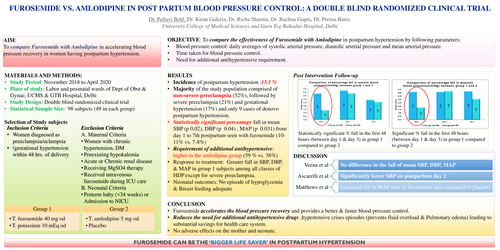
• Incidence of postpartum hypertension :13.1 %
• Majority of the study population comprised of
non-severe preeclampsia (52%), followed by severe preeclampsia (21%) and gestational hypertension (17%) and only 9 cases of denovo postpartum hypertension.
• Statistically significant percentage fall in mean SBP (p 0.02), DBP (p 0.04) , MAP (p 0.031) from day 1 to 7th postpartum seen with furosemide (10- 11% vs. 7-8%)
• Requirement of additional antihypertensive: higher in the amlodipine group (59 % vs. 38%)
• Response to treatment: Greater fall in SBP, DBP, & MAP in group 1 subjects among all classes of HDP except for severe preeclampsia.
• Neonatal outcomes: No episode of hypoglycemia & Breast feeding adequate
Post Intervention Follow-up
Statistically significant % fall in the first 48 hours (between day 1 & day 3) in group 1 compared to group 2
Significant % fall in the first 48 hours (between day 1 & day 3) in group 1 compared to group 2
DISCUSSION
Veena et al
Ascarelli et al Matthews et al
No difference in the fall of mean SBP, DBP, MAP
Significantly lower SBP on postpartum day 2
Sustained fall in MAP seen in furosemide arm compared to placebo
CONCLUSION
• Furosemide accelerates the blood pressure recovery and provides a better & faster blood pressure control.
• Reduces the need for additional antihypertensive drugs ,hypertensive crises episodes (prevents fluid overload & Pulmonary edema) leading to
substantial savings for health care system.
• No adverse effects on the mother and neonate.
FUROSEMIDE CAN BE THE ‘BIGGER LIFE SAVER’ IN POSTPARTUM HYPERTENSION