1,830 posters, 67 videos, 75 audios, 29 topics, 22 sessions, 4,727 authors, 1,697 institutions
ePostersLive by SciGen Technologies S.A. All rights reserved.
RCOG World Congress 2023
June 12 - 14, 2023 | London, UK

EP.0421
Coexistence of Mayer- Rokitansky-Küster- Hauser Syndrome and Gonadal Dysgenesis.
Poster Presenter
Authors
Affiliations
Part of Topic
Adolescent Gynaecology
Coexistence of Mayer Rokitansky Syndrome & Gonadal Dysgenesis
Introduction: Congenital absence of Mullerian duct derivatives, known as Mayer Rokitansky Kuster Hauser syndrome is a rare condition, It is usually associated with urological and skeletal abnormalities. Its association with bilateral gonadal Dysgenesis is extremely rare and appears to be independent of chromosomal abnormalities.
Case Report:
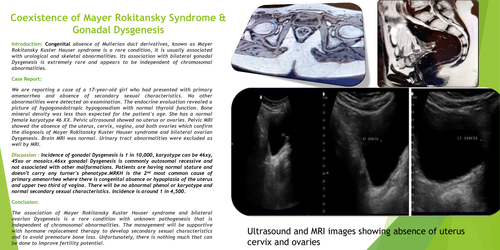
We are reporting a case of a 17-year-old girl who had presented with primary amenorrhea and absence of secondary sexual characteristics. No other abnormalities were detected on examination. The endocrine evaluation revealed a picture of hypogonadotropic hypogonadism with normal thyroid function. Bone mineral density was less than expected for the patient's age. She has a normal female karyotype 46 XX. Pelvic ultrasound showed no uterus or ovaries. Pelvic MRI showed the absence of the uterus, cervix, vagina, and both ovaries which confirm the diagnosis of Mayer Rokitansky Kuster Hauser syndrome and bilateral ovarian Dysgenesis. Brain MRI was normal. Urinary tract abnormalities were excluded as well by MRI.
Discussion : Incidence of gonadal Dysgenesis is 1 in 10,000, karyotype can be 46xy, 45xo or mosaics.46xx gonadal Dysgenesis is commonly autosomal recessive and not associated with other malformations. Patients are having normal stature and doesn’t carry any turner's phenotype.MRKH is the 2nd most common cause of primary amenorrhea where there is congenital absence or hypoplasia of the uterus and upper two third of vagina. There will be no abnormal phenol or karyotype and normal secondary sexual characteristics. Incidence is around 1 in 4,500.
Conclusion:
The association of Mayer Rokitansky Kuster Hauser syndrome and bilateral ovarian Dysgenesis is a rare condition with unknown pathogenesis that is independent of chromosomal abnormalities. The management will be supportive with hormone replacement therapy to develop secondary sexual characteristics and to avoid premature bone loss. Unfortunately, there is nothing much that can be done to improve fertility potential.