1,830 posters, 67 videos, 75 audios, 29 topics, 22 sessions, 4,727 authors, 1,697 institutions
ePostersLive by SciGen Technologies S.A. All rights reserved.
RCOG World Congress 2023
June 12 - 14, 2023 | London, UK

EP.0402
Presentation of a giant 7-centimetre Nabothian cyst mimicking cervical malignancy
Poster Presenter
Authors
Affiliations
Part of Topic
Gynae Oncology
Presentation of a giant 7-centimeter Nabothian cyst mimicking cervical malignancy
Authors: N Marathum, S Addley, S Abdul
Derby Gynaecological Cancer Centre
Objective
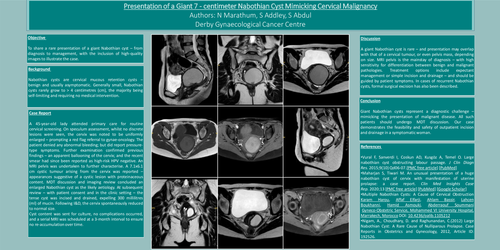
To share a rare presentation of a giant Nabothian cyst – from diagnosis to management, with the inclusion of high-quality images to illustrate the case.
Background
Nabothian cysts are cervical mucous retention cysts – benign and usually asymptomatic. Generally, small in size, Nabothian cysts rarely grow to > 4 centimeters (cm), the majority being self-limiting and requiring no medical intervention.
Case report
A 45-year-old lady attended primary care for routine cervical screening. On speculum assessment, whilst no discrete lesions were seen, the cervix was noted to be uniformly enlarged – prompting a red flag referral to gynae-oncology. The patient denied any abnormal bleeding but did report pressure-type symptoms. Further examination confirmed previous findings – an apparent ballooning of the cervix, and the recent smear had since been reported as high-risk HPV negative. An MRI pelvis was undertaken to further characterise. A 7.1x6.1 cm cystic tumour arising from the cervix was reported – appearances suggestive of a cystic lesion with proteinaceous content. MDT discussion and imaging review concluded an enlarged Nabothian cyst as the likely aetiology. At subsequent review – with patient consent and in the clinic setting – the tense cyst was incised and drained, expelling 300 milliliters of mucin. Following I&D, the cervix spontaneously reduced to normal size. Cyst content was sent for culture, no complications occurred and a serial MRI was scheduled at a 3-month interval to ensure no re-accumulation over time.
Discussion
A giant Nabothian cyst is rare – and presentation may overlap with that of a cervical tumour, or even pelvis mass, depending on size. MRI pelvis is the mainstay of diagnosis – with high sensitivity for differentiation between benign and malignant pathologies. Treatment options include expectant management or simple incision and drainage – and should be guided by patient symptoms. In cases of recurrent Nabothian cysts, formal surgical excision has also been described.
Conclusion
Giant Nabothian cysts represent a diagnostic challenge – mimicking the presentation of malignant disease. All such patients should undergo MDT discussion. Our case demonstrates the feasibility and safety of outpatient incision and drainage in a symptomatic woman.
References
Gyneco-Obstetric Service, Mohammed VI University Hospital, Marrakech, Morocco DOI: 10.4236/oalib.1105212