1,830 posters, 67 videos, 75 audios, 29 topics, 22 sessions, 4,727 authors, 1,697 institutions
ePostersLive by SciGen Technologies S.A. All rights reserved.
RCOG World Congress 2023
June 12 - 14, 2023 | London, UK

EP.0396
Late presentation of broad ligament haematoma and uterine necrosis requiring hysterectomy
Poster Presenter
Authors
Affiliations
Part of Topic
Labour Ward Management
LATE PRESENTATION OF BROAD LIGAMENT HAEMATOMA AND UTERINE NECROSIS REQUIRING HYSTERECTOMY
INTRODUCTION
Broad ligament haematomas are a rare complication in obstetrics. In most cases they will present with acute haemodynamic instability within a few hours of delivery1. They often occur because of upper vaginal, cervical, or uterine tears extending into the uterine or vaginal arteries1. Although they can occur after spontaneous vaginal and instrumental birth, broad ligament haematomas are a known complication during Caesarean Section1. Prompt diagnosis and timely intervention are important forsuccessful management to reduce maternal morbidity and mortality2. Management options vary depending on size of the haematoma and the patients haemodynamic situation.
We present an unusual case of three late presentations with secondary post-partum haemorrhage (PPH) caused by a broad ligament haematoma, with the patient developing infection, progressing to sepsis secondary to uterine necrosis, which required a hysterectomy six weeks postpartum.
CASE REPORT
A 41-year-old, para 1, who was 39 weeks pregnant underwent an emergency caesarean delivery due to CTG concerns in labour. Her obstetric history included an instrumental delivery fourteen years previously. She had no significant medical or surgical history. She had been admitted for induction of labour for maternal age and had received two prostaglandin pessaries, an artificial rupture of membranes and had progressed spontaneously following this to 9cm. The decision was then made to deliver via Category 2 Caesarean section due to fetal distress. The Caesarean was complicated by a uterine angle extension and haemorrhage of 1500mls. During the Caesarean a left broad ligament haematoma was noted, and additional haemostatic sutures were required at the uterine extension. The patient underwent an uncomplicated recovery and was discharged on day 3 with a stable haemoglobin of 98.
First Presentation:
She presented with a secondary PPH and pyrexia on day 13 post-delivery. She was haemodynamically stable and was managed conservatively with intravenous antibiotics, and tranexamic acid and uterotonics (Misoprostol and Syntometrine), for presumed endometritis. She was discharged after one day with oral antibiotics and a haemoglobin of 84.
Second Presentation:
The patient re-presented with a further PPH and haemodynamic instability two days later. Her haemoglobin was 74 and her clotting profile was deranged. She underwent an examination under anaesthesia with intraoperative ultrasound suggestive of retained products of conception and an evacuation of retained products was performed. She received four units of fresh frozen plasma, two units of cryoprecipitate and three units of red blood cells. Post-operatively her bleeding settled, and she was discharged three days later with oral iron and a haemoglobin of 85.
Third Presentation:
The patient presented four weeks later with a significant PPH and sepsis with associated haemodynamic instability. A transvaginal ultrasound scan showed a haematoma close to the incision site on the uterus, and no evidence of retained products. The histology from the previous uterine evacuation was reviewed and there had been no residual chorionic villi found.
She underwent an emergency laparotomy with intraoperative findings of a left sided 4x4cm broad ligament haematoma above the left ureter and necrosis at the interface of the bladder and cervix, with a necrotic cavity in the broad ligament. A subtotal abdominal hysterectomy with bilateral salpingectomies was performed. Cystoscopy and retrograde ureteroscopy confirmed there was no evidence of bladder or ureteric injury.
Postoperatively she was admitted to intensive care and treated for sepsis with intravenous antibiotics. She was discharged after eight days with oral iron and six weeks of low molecular weight heparin, and a clinic appointment for debriefing.
DISCUSSION
Although broad ligament haematomas are a known complication during caesarean section, there are not many cases in the literature of a delayed presentation associated with sepsis and uterine necrosis with the need for hysterectomy. As this is uncommon, there was not a high level of suspicion leading to early detection in this case.
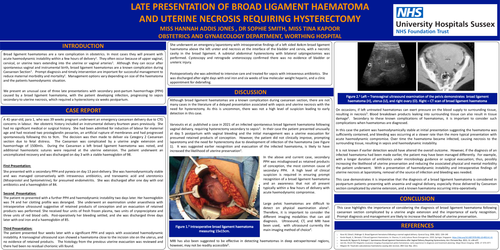
Varvoutis et al. published a case in 2021 of an infected spontaneous broad ligament haematoma following vaginal delivery, requiring hysterectomy secondary to sepsis3. In their case the patient presented unusually at day 5 postpartum with vaginal bleeding and the initial management was a uterine evacuation for presumed retained products of conception. However, the patient did not clinically improve, prompting laparotomy and the need for hysterectomy due to development of infection of the haematoma (see Figure 1). It was suggested earlier recognition and evacuation of the infected haematoma, is likely to have increased the likelihood of uterine preservation3.
In the above and current case, secondary PPH was misdiagnosed as retained products of conception, the most common cause of secondary PPH. A high level of clinical suspicion is required in ensuring prompt recognition of a broad ligament haematoma and an awareness that not all present typically within a few hours of delivery with acute haemodynamic compromise.
Large pelvic haematomas are difficult to detect on physical examination alone1. Therefore, it is important to consider the different imaging modalities that can aid diagnosis. Ultrasound, CT, and MRI have been used, with ultrasound currently the main imaging method of choice4.
MRI has also been suggested to be effective in detecting haematomas in deep extraperitoneal regions, however, may not be readily accessible5.
On occasions, if left untreated haematomas can exert pressure on the blood supply to surrounding tissue, resulting in necrosis5. Blood breakdown products leaking into surrounding tissue can also result in tissue damage5. Secondary to these known complications of haematomas, it is important to consider such complications whenhaematomas are diagnosed.
In this case the patient was haemodynamically stable at initial presentation suggesting the haematoma was sufficiently contained, and bleeding was occurring at a slower rate than the more typical presentation with acute haemodynamic compromise. Over time the haematoma became infected, causing necrosis to the surrounding tissue, resulting in sepsis and haemodynamic instability.
It is not known if earlier detection would have altered the overall outcome. However, if the diagnosis of an infected haematoma had been made earlier, the patient may have been managed differently. For example, with a longer duration of antibiotics under microbiology guidance or surgical evacuation; thus, possibly increasing the likelihood of uterine preservation and reducing the associated physical and mental morbidity the patient underwent. With a presentation of haemodynamic instability and intraoperative findings of uterine necrosis at laparotomy, removal of the source of infection and bleeding was needed.
This case demonstrates it is imperative that the diagnosis of a broad ligament haematoma is considered in postpartum patients presenting with anaemia and vaginal delivery, especially those delivered by Caesarean section complicated by uterine extension, and a known haematoma occurring intra-operatively.
CONCLUSION
This case highlights the importance of considering the diagnosis of broad ligament haematoma following caesarean section complicated by a uterine angle extension and the importance of early recognition. Prompt diagnosis and management are likely to increase the likelihood of uterine preservation.