1,830 posters, 67 videos, 75 audios, 29 topics, 22 sessions, 4,727 authors, 1,697 institutions
ePostersLive by SciGen Technologies S.A. All rights reserved.
RCOG World Congress 2023
June 12 - 14, 2023 | London, UK

EP.0378
Report of a Rare Case of Dysgerminoma:
Poster Presenter
Authors
Affiliations
Part of Topic
Gynae Oncology
Report of Rare Case of Dysgerminoma
Objective:
To report a rare case of Dysgerminoma with extremely complicated course of disease.
Case Report:
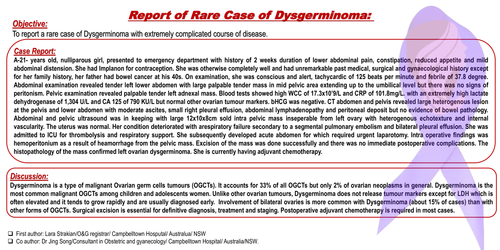
A-21- years old, nulliparous girl, presented to emergency department with history of 2 weeks duration of lower abdominal pain, constipation, reduced appetite and mild abdominal distension. She had Implanon for contraception. She was otherwise completely well and had unremarkable past medical, surgical and gynaecological history except for her family history, her father had bowel cancer at his 40s. On examination, she was conscious and alert, tachycardic of 125 beats per minute and febrile of 37.8 degree. Abdominal examination revealed tender left lower abdomen with large palpable tender mass in mid pelvic area extending up to the umbilical level but there was no signs of peritonism. Pelvic examination revealed palpable tender left adnexal mass. Blood tests showed high WCC of 17.3x10’9/L and CRP of 101.8mg/L. with an extremely high lactate dehydrogenase of 1,304 U/L and CA 125 of 790 KU/L but normal other ovarian tumour markers. bHCG was negative. CT abdomen and pelvis revealed large heterogenous lesion at the pelvis and lower abdomen with moderate ascites, small right pleural effusion, abdominal lymphadenopathy and peritoneal deposit but no evidence of bowel pathology. Abdominal and pelvic ultrasound was in keeping with large 12x10x8cm sold intra pelvic mass inseperable from left ovary with heterogenous echotexture and internal vascularity. The uterus was normal. Her condition deteriorated with arespiratory failure secondary to a segmental pulmonary embolism and bilateral pleural effusion. She was admitted to ICU for thrombolysis and respiratory support. She subsequently developed acute abdomen for which required urgent laparotomy. Intra operative findings was hemoperitonium as a result of heamorrhage from the pelvic mass. Excision of the mass was done successfully and there was no immediate postoperative complications. The histopathology of the mass confirmed left ovarian dysgerminoma. She is currently having adjuvant chemotherapy.
Discussion:
Dysgerminoma is a type of malignant Ovarian germ cells tumours (OGCTs). It accounts for 33% of all OGCTs but only 2% of ovarian neoplasms in general. Dysgerminoma is the most common malignant OGCTs among children and adolescents women. Unlike other ovarian tumours, Dysgerminoma does not release tumour markers except for LDH which is often elevated and it tends to grow rapidly and are usually diagnosed early. Involvement of bilateral ovaries is more common with Dysgerminoma (about 15% of cases) than with other forms of OGCTs. Surgical excision is essential for definitive diagnosis, treatment and staging. Postoperative adjuvant chemotherapy is required in most cases.
Conclusion:
Dysgerminoma is a rare form of ovarian neoplasm. Whilst the presentation can be nonspecific, life threatening complications can occur early in the course of disease.