1,830 posters, 67 videos, 75 audios, 29 topics, 22 sessions, 4,727 authors, 1,697 institutions
ePostersLive by SciGen Technologies S.A. All rights reserved.
RCOG World Congress 2023
June 12 - 14, 2023 | London, UK

EP.0374
Struma Ovarii
Poster Presenter
Part of Topic
Gynae Oncology
Struma Ovarii: A Case Study
Objectives
Struma ovarii are rare ovarian tumours, of monodermal germ cell origin, containing predominantly thyroid tissue. They are typically benign unilateral pelvic masses, however, malignant transformation is sometimes detected. Symptoms are generally non-specific and thyroid function indices are almost always normal. Here we report a case of struma ovarii to highlight the heterogenous clinical presentation of this condition.
Case Report
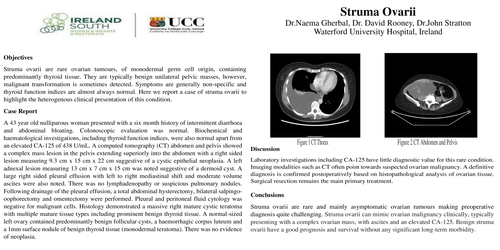
A 43 year old nulliparous woman presented with a six month history of intermittent diarrhoea and abdominal bloating. Colonoscopic evaluation was normal. Biochemical and haematological investigations, including thyroid function indices, were also normal apart from an elevated CA-125 of 438 U/mL. A computed tomography (CT) abdomen and pelvis showed a complex mass lesion in the pelvis extending superiorly into the abdomen with a right sided lesion measuring 9.3 cm x 15 cm x 22 cm suggestive of a cystic epithelial neoplasia. A left adnexal lesion measuring 13 cm x 7 cm x 15 cm was noted suggestive of a dermoid cyst. A large right sided pleural effusion with left to right mediastinal shift and moderate volume ascites were also noted. There was no lymphadenopathy or suspicious pulmonary nodules. Following drainage of the pleural effusion, a total abdominal hysterectomy, bilateral salpingo-oophorectomy and omentectomy were performed. Pleural and peritoneal fluid cytology was negative for malignant cells. Histology demonstrated a massive right mature cystic teratoma with multiple mature tissue types including prominent benign thyroid tissue. A normal-sized left ovary contained predominantly benign follicular cysts, a haemorrhagic corpus luteum and a 1mm surface nodule of benign thyroid tissue (monodermal teratoma). There was no evidence of neoplasia.
Discussion
Laboratory investigations including CA-125 have little diagnostic value for this rare condition. Imaging modalities such as CT often point towards suspected ovarian malignancy. A definitive diagnosis is confirmed postoperatively based on histopathological analysis of ovarian tissue. Surgical resection remains the main primary treatment.
Conclusions
Struma ovarii are rare and mainly asymptomatic ovarian tumours making preoperative diagnosis quite challenging. Struma ovarii can mimic ovarian malignancy clinically, typically presenting with a complex ovarian mass, with ascites and an elevated CA-125. Benign struma ovarii have a good prognosis and survival without any significant long-term morbidity.