1,830 posters, 67 videos, 75 audios, 29 topics, 22 sessions, 4,727 authors, 1,697 institutions
ePostersLive by SciGen Technologies S.A. All rights reserved.
RCOG World Congress 2023
June 12 - 14, 2023 | London, UK

EP.0373
Miller Fisher variant of Guillain barre syndrome presenting perinatally - A case report.
Poster Presenter
Authors
Affiliations
Part of Topic
High Risk Pregnancy
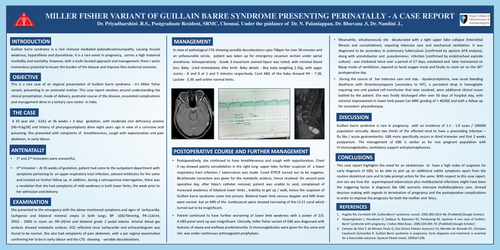
MILLER FISHER VARIANT OF GUILLAIN BARRE SYNDROME PRESENTING PERINATALLY - A CASE REPORT
Dr. Priyadharshini .R.S., Postgraduate Resident, SRMC, Chennai. Under the guidance of Dr. N. Palaniappan, Dr. Bhuvana .S, Dr. Nandini .L.
INTRODUCTION
Guillain barre syndrome is a rare immune mediated polyradiculoneuropathy, causing muscle weakness, hyporeflexia and dysesthesia. It is a rare event in pregnancy, carries a high maternal morbidity and mortality. However, with a multi-faceted approach and management, there I exists tremendous potential to lessen the burden of the disease and improve feto-maternal outcome.
OBJECTIVE
This is a rare case of an atypical presentation of Guillain barre syndrome - it’s Miller fisher variant, presenting in an antenatal mother. This case report revolves around understanding the clinical presentation, mode of delivery, postnatal course of the disease, associated complications and management done in a tertiary care center in India.
THE CASE
A 35 year old , G2A1 at 36 weeks + 3 days gestation, with moderate iron deficiency anemia [Hb–9.6g/dl] and history of pharyngocoloplasty done eight years ago in view of a corrosive acid poisoning. She presented with complaints of breathlessness, cough with expectoration and pain abdomen, in early labour.
ANTENATALLY
-
1st and 2nd trimesters were uneventful.
-
3rd trimester – At 35 weeks of gestation, patient had come to the outpatient department with
symptoms pertaining to an upper respiratory tract infection, advised antibiotics for the same and insisted on further follow up. In addition, during a retrospective interrogation, there was a revelation that she had complaints of mild weakness in both lower limbs, the week prior to her admission and delivery.
EXAMINATION
She presented to the emergency with the above mentioned symptoms and signs of tachycardia, tachypnea and bilateral minimal crepts in both lungs. BP -100/70mmhg, PR-114/mt, SPO2 - 100% in room air, RR–24/mt and bilateral grade 2 pedal edema. Arterial blood gas analysis showed metabolic acidosis. ECG reflected sinus tachycardia and echocardiogram was found to be normal. She also had complaints of pain abdomen, with a per vaginal examination confirming her to be in early labour and the CTG showing - variable deccelerations.
MANAGEMENT
In view of pathological CTG showing variable deccelerations upto 70bpm for over 30 minutes and an unfavourable cervix, patient was taken up for emergency cesarean section under spinal anesthesia. Intraoperatively - Grade 3 meconium stained liqour was noted, with minimal blood loss. Baby cried immediately after birth. Baby details - Boy baby weighing 2.1Kg, with apgar scores - 8 and 9 at 1 and 5 minutes respectively. Cord ABG of the baby showed PH - 7.28, Lactate - 3.39, well within normal limits.
POSTOPERATIVE COURSE AND FURTHER MANAGEMENT
-
Postoperatively, she continued to have breathlessness and cough with expectoration, Chest X ray showed patchy consolidation in the right lung -upper lobe, further suspicion of a lower respiratory tract infection / tuberculosis was made. Covid RTPCR turned out to be negative. Bicarbonate correction was given for the metabolic acidosis, hence resolved. On second post operative day, after foley’s catheter removal, patient was unable to void, complained of increased weakness of bilateral lower limbs , inability to get up / walk, hence the suspicion of Guillain barre syndrome came into picture. Bilateral lower limb venous doppler and MRI brain were normal but an MRI of the lumbosacral spine showed narrowing of the L5-S1 canal which turned out to be insignificant.
-
Patient continued to have further worsening of lower limb weakness with a power of 2/5. A GBS panel work up was insignificant. Clinically, miller fisher variant of GBS was diagnosed with features of ataxia and areflexia predominantly. IV immunoglobulins were given for the same and she was under continuous anticoagulant prophylaxis.
• Meanwhile, simultaneously she desaturated with a right upper lobe collapse {Interstitial fibrosis and consolidation}, requiring intensive care and mechanical ventilation. It was diagnosed to be secondary to pulmonary tuberculosis [confirmed by sputum AFB analysis], along with acinetobactor and pseudomonas infection [confirmed by endotracheal aspirate culture] - was intubated twice over a period of 27 days, extubated and later maintained on Bipap mode of ventilation, tapered to facial oxygen mask and finally to room air on the 36th postoperative day.
• During the course of her intensive care unit stay - dyselectrolytemia, new onset bleeding diasthesis with thrombocytopenia [secondary to HIT], a persistent drop in hemoglobin requiring one unit packed cell transfusion that later resolved, were additional clinical issues battled by the patient. She was finally discharged after over 50 days of hospital stay, with minimal improvement in lower limb power [an MRC grading of > 40/60] and with a follow up for consistent physiotherpay.
DISCUSSION
Guillain barre syndrome is rare in pregnancy with an incidence of 1.2 - 1.9 cases / 100000 population annually. About two thirds of the affected tend to have a preceeding infection –flu like / acute gastroenteritis. GBS more specifically occurs in third trimester and first 2 weeks postpartum. The management of GBS is similar as for non pregnant population with IV immunoglobulins, ventilatory support and plasmapheresis.
CONCLUSIONS
This case report highlights the need for an obstetrician to have a high index of suspicion for early diagnosis of GBS, to be able to pick up on additional sublte symptoms apart from the routine obstetrical care and to take prompt action for the same. With respect to this case report, one can see how the superimposed tuberculosis plus multibacterial infections might have been the triggering factor. A diagnosis like GBS warrants intensive multidisciplinary care, shrewd decision making with regards to termination of pregnancy and the postoperative complications in order to improve the prognosis for both the mother and fetus.
REFERENCES
-
Hughes RA, Cornblath DR. GuillainBarre’ syndrome. Lancet. 2005;366:1653–66. [PubMed] [Google Scholar]
-
Vijayaraghavan J, Vasudevan D, Sadique N, Rajeswari KS, Pondurangi M, Jayshree A rare case of Guillain-
Barre’ syndrome with pregnancy. J Indian Med Assoc. 2006;104:269–70. [PubMed] [Google Scholar]
-
Campos da Silva F, de Moraes Paula G, Dos Santos Esteves Automari CV, Mendes de Almeida DS, Ubirajara Cavalcanti Guimarães R. Guillain-Barre syndrome in pregnancy: Early diagnosis and treatment is essential
for a favourable outcome. Gynecol Obstet Invest. 2009;67:236.