1,830 posters, 67 videos, 75 audios, 29 topics, 22 sessions, 4,727 authors, 1,697 institutions
ePostersLive by SciGen Technologies S.A. All rights reserved.
RCOG World Congress 2023
June 12 - 14, 2023 | London, UK

EP.0372
Embryonal rhabdomyosarcoma: very rare aggressive cancer in a young woman
Poster Presenter
Authors
Lujain Lataifeh, Isam Lataifeh, Jumana Alrajabi, Alanoud Albustanji, Esraa Shraim
Affiliations
Part of Topic
Gynae Oncology
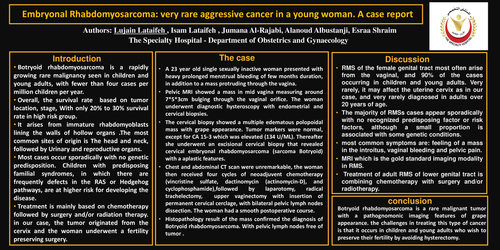
Embryonal Rhabdomyosarcoma: very rare aggressive cancer in a young woman. A case report
Authors: Lujain Lataifeh , Isam Lataifeh Jumana Al-Rajabi, Alanoud Albustanji, Esraa Shraim
The Specialty Hospital - Department of Obstetrics and Gynaecology
Introduction
- Botryoid rhabdomyosarcoma is a rapidly growing rare malignancy seen in children and young adults, with fewer than four cases per million children per year.
- Overall, the survival rate based on tumor location, stage, With only 20% to 30% survival rate in high risk group.
- It arises from immature rhabdomyoblasts lining the walls of hollow organs .The most common sites of origin is The head and neck, followed by Urinary and reproductive organs.
- Most cases occur sporadically with no genetic predisposition. Children with predisposing familial syndromes, in which there are frequently defects in the RAS or Hedgehog pathways, are at higher risk for developing the disease.
- Treatment is mainly based on chemotherapy followed by surgery and/or radiation therapy. in our case, the tumor originated from the cervix and the woman underwent a fertility preserving surgery.
The case
- A 23 year old single sexually inactive woman presented with heavy prolonged menstrual bleeding of few months duration, in addition to a mass protruding through the vagina.
- Pelvic MRI showed a mass in mid vagina measuring around 7*5*3cm bulging through the vaginal orifice. The woman underwent diagnostic hysteroscopy with endometrial and cervical biopsies.
- The cervical biopsy showed a multiple edematous polopoidal mass with grape appearance. Tumor markers were normal, except for CA 15-3 which was elevated (134 U/ML). Thereafter she underwent an excisional cervical biopsy that revealed cervical embryonal rhabdomyosarcoma (sarcoma Botryoid) with a aplastic features.
- Chest and abdominal CT scan were unremarkable, the woman then received four cycles of neoadjuvent chemotherapy (vincristine sulfate, dactinomycin (actinomycin-D), and cyclophosphamide),followed by laparotomy, radical trachelectomy, upper vaginectomy with insertion of permanent cervical cerclage, with bilateral pelvic lymph nodes dissection. The woman had a smooth postoperative course.
- Histopathology result of the mas confirmed the diagnosis of Botryoid rhabdomyosarcoma. With pelvic lymph nodes free of tumor .
Discussion
- RMS of the female genital tract most often arise from the vaginal, and 90% of the cases occurring in children and young adults. Very rarely, it may affect the uterine cervix as in our case, and very rarely diagnosed in adults over 20 years of age.
- The majority of RMSs cases appear sporadically with no recognized predisposing factor or risk factors, although a small proportion is associated with some genetic conditions.
- most common symptoms are: feeling of a mass in the introitus, vaginal bleeding and pelvic pain.
- MRI which is the gold standard imaging modality in RMS.
- Treatment of adult RMS of lower genital tract is combining chemotherapy with surgery and/or radiotherapy.
conclusion
- Botryoid rhabdomyosarcoma is a rare malignant tumor with a pathognomonic imaging features of grape appearance. the challenges in treating this type of cancer is that it occurs in children and young adults who wish to preserve their fertility by avoiding hysterectomy.