1,830 posters, 67 videos, 75 audios, 29 topics, 22 sessions, 4,727 authors, 1,697 institutions
ePostersLive by SciGen Technologies S.A. All rights reserved.
RCOG World Congress 2023
June 12 - 14, 2023 | London, UK

EP.0352
Ovarian Dysgerminoma
Poster Presenter
Authors
Affiliations
Part of Topic
Gynae Oncology
Ovarian Dysgerminoma
Objective
Ovarian malignant germ cell tumors represent less than 10% of all ovarian tumors. Dysgerminoma is the most common malignant primitive germ cell tumor in young women, known for its curability and low propensity to invade and metastasize when diagnosed early. Here in, we report an unusual type of ovarian dysgerminoma presentation.
Case Report
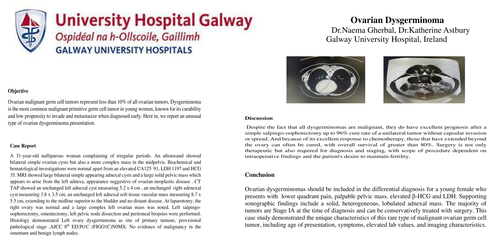
A 31-year-old nulliparous woman complaining of irregular periods. An ultraosund showed bilateral simple ovarian cysts but also a more complex mass in the midpelvis. Biochemical and hematological investigations were normal apart from an elevated CA125 91, LDH 1197 and HCG 35. MRI showed large bilateral simple appearing adnexal cysts and a large solid pelvic mass which appears to arise from the left adnexa, appearance suggestive of ovarian neoplastic disease . CT TAP showed an unchanged left adnexal cyst measuring 5.2 x 4 cm , an unchanged right adenexal cyst measuring 3.8 x 3.5 cm, an unchanged left adnexal soft tissue vascular mass measuring 8.7 x 5.5 cm, extending to the midline superior to the bladder and no distant disease. At laparotomy, the right ovary was normal and a large complex left ovarian mass was noted. Left salpingo-oophorectomy, omentectomy, left pelvic node dissection and peritoneal biopsies were performed. Histology demonstrated Left ovary dysgerminoma as site of primary tumour, provisional pathological stage ,AJCC 8th ED:Pt1C (FIGO1C)N0MX. No evidence of malignancy in the omentum and benign lymph nodes.
Discussion
Despite the fact that all dysgerminomas are malignant, they do have excellent prognosis after a simple salpingo-oophorectomy up to 96% cure rate of a unilateral tumor without capsular invasion or spread. And because of its excellent response to chemotherapy, those that have extended beyond the ovary can often be cured, with overall survival of greater than 80%. Surgery is not only therapeutic but also required for diagnosis and staging, with scope of procedure dependent on intraoperative findings and the patient's desire to maintain fertility.
Conclusion
Ovarian dysgerminomas should be included in the differential diagnosis for a young female who presents with lower quadrant pain, palpable pelvic mass, elevated β-HCG and LDH. Supporting sonographic findings include a solid, heterogeneous, lobulated adnexal mass. The majority of tumors are Stage IA at the time of diagnosis and can be conservatively treated with surgery. This case study demonstrated the unique characteristics of this rare type of malignant ovarian germ cell tumor, including age of presentation, symptoms, elevated lab values, and imaging characteristics.