1,830 posters, 67 videos, 75 audios, 29 topics, 22 sessions, 4,727 authors, 1,697 institutions
ePostersLive by SciGen Technologies S.A. All rights reserved.
RCOG World Congress 2023
June 12 - 14, 2023 | London, UK

EP.0350
Spontaneous Liver Capsule Rupture in Pregnancy
Poster Presenter
Authors
Gurnaaz Kahlon, Tetyana Palamarchuk, Chloe Hall, Ramesan Navaratnarajah
Affiliations
Part of Topic
High Risk Pregnancy
Video
SPONTANEOUS LIVER CAPSULE RUPTURE IN PREGNANCY
Gurnaaz Kahlon, Tetyana Palamarchuk, Chloe Hall, Ramesan Navaratnarajah
Introduction
Spontaneous liver capsule rupture (SLCR) in pregnancy is a rare but life-threatening condition for both the fetus and mother. Most commonly it is preceded by HELLP syndrome however it can present in different ways and be associated with other liver pathology. We present the case of SLCR in the third trimester.
Case presentation
Background
A 35-year-old G3P2 Filipino women booked at 12+2 weeks. Her BMI was 31. She had a history of GDM in her previous pregnancies and LGA (both babies > 4000g). Both had been delivered by emergency caesarean section (cs) and of note there was a uterine scar dehiscence at her last cs.
Antenatal care
The 20-week anomaly scan showed raised uterine artery PI . Again, she was diagnosed with GDM and required Metformin. At 30 weeks Labetalol 200mg BD was commenced for PIH, urine PCR was 27. She underwent regular BP and urine checks and serial growth scans showed normal growth just above the 50th centile. At 35 and 36 weeks the umbilical artery PI was raised, testing for pre-eclampsia was offered however she declined. A plan had been made for elective cs and bilateral tubal ligation.
Emergency presentation
At 37+1 she presented with abdominal pain and shoulder pain. She appeared unwell and short of breath. The CTG was pathological and a decision made for a category 1 cs for suspected uterine rupture. On entry haemoperitoneum was confirmed however the uterus was intact. The baby was delivered in a good condition and the uterus repaired. On further inspection it was noted the bleeding was arising from the right upper quadrant and the surface of the liver was irregular. The oncall surgeon was called who was a Hepato-Pancreatico-Biliary (HPB) consultant and in the interim the abdominal cavity was packed. The HPB consultant arrived, and the incision was converted to an inverted T. The bleeding was confirmed to be from a liver capsule rupture likely due to a ruptured haemangioma. The bleeding had settled after removal of packing therefore TachoSil (a haemostatic agent) was applied over the area. There was no further bleeding. A Robinson drain was left insitu. The EBL was 2000ml and she was transfused 3 units of packed red calls and 4 units of fresh frozen plasma and an arterial line sited
Postnatal care
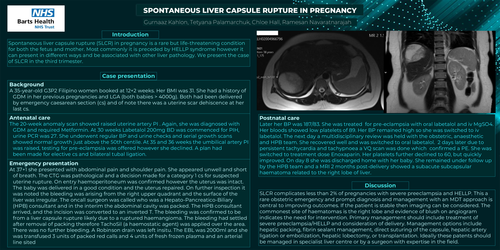
Later her BP was 187/83. She was treated for pre-eclampsia with oral labetalol and iv MgSO4. Her bloods showed low platelets of 89. Her BP remained high so she was switched to iv labetalol. The next day a multidisciplinary review was held with the obstetric, anaesthetic and HPB team. She recovered well and was switched to oral labetalol. 2 days later due to persistent tachycardia and tachypnoea a VQ scan was done which confirmed a PE. She was switched to treatment dose Enoxaparin. Her platelets further declined to 60, but quickly improved. On day 8 she was discharged home with her baby. She remained under follow up by the HPB team and a MRI 2 months post-delivery showed a subacute subcapsular haematoma related to the right lobe of liver.
Discussion
SLCR complicates less than 2% of pregnancies with severe preeclampsia and HELLP. This a rare obstetric emergency and prompt diagnosis and management with an MDT approach is central to improving outcomes. If the patient is stable then imaging can be considered. The commonest site of haematomas is the right lobe and evidence of blush on angiogram indicates the need for intervention. Primary management should include treatment of severe preeclampsia/HELLP and consideration of delivery. Management options include hepatic packing, fibrin sealant management, direct suturing of the capsule, hepatic artery ligation or embolization, hepatic lobectomy, or transplantation. Ideally these patents should be managed in specialist liver centre or by a surgeon with expertise in the field.