1,830 posters, 67 videos, 75 audios, 29 topics, 22 sessions, 4,727 authors, 1,697 institutions
ePostersLive by SciGen Technologies S.A. All rights reserved.
RCOG World Congress 2023
June 12 - 14, 2023 | London, UK

EP.0346
Delayed-interval delivery in dichorionic twin pregnancy: case report of 91 latency days
Poster Presenter
Part of Topic
High Risk Pregnancy
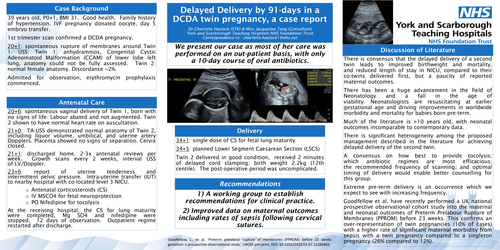
Delayed Delivery by 91-days in a DCDA twin pregnancy, a case report
We present our case as most of her care was performed on an out-patient basis, with only a 10-day course of oral antibiotics.
Discussion of Literature
There is consensus that the delayed delivery of a second twin leads to improved birthweight and mortality, and reduced length of stay in NICU, compared to their co-twins delivered first, but a paucity of reported maternal outcomes.
There has been a huge advancement in the field of Neonatology and a fall in the age of viability. Neonatologists are resuscitating at earlier gestational age and driving improvements in worldwide morbidity and mortality for babies born pre-term.
Much of the literature is >10 years old, with neonatal outcomes incomparable to contemporary data.
There is significant heterogeneity among the proposed management described in the literature for achieving delayed delivery of the second twin.
A consensus on how best to provide tocolysis; which antibiotic regimes are most efficacious; the recommended frequency of scanning; and optimal timing of delivery would enable better counselling for this group.
Extreme pre-term delivery is an occurrence which we expect to see with increasing frequency.
Goodfellow et al. have recently performed a UK national prospective observational cohort study into the maternal and neonatal outcomes of Preterm Prelabour Rupture of Membranes (PPROM) before 23 weeks. This confirms an over-representation of twin pregnancies (10% of cases) with a higher rate of significant maternal morbidity from sepsis with a twin pregnancy compared to a singleton pregnancy (26% compared to 12%).
Recommendations
1) A working group to establish recommendations for clinical practice.
2) Improved data on maternal outcomes including rates of sepsis following cervical sutures.