1,830 posters, 67 videos, 75 audios, 29 topics, 22 sessions, 4,727 authors, 1,697 institutions
ePostersLive by SciGen Technologies S.A. All rights reserved.
RCOG World Congress 2023
June 12 - 14, 2023 | London, UK

EP.0344
Extragonadal mature teratoma in the uterine cervix in an adolescent girl
Poster Presenter
Part of Topic
Benign Gynaecology
Title:
Extragonadal mature teratoma in the uterine cervix in an adolescent girl
Objective:
Teratomas in extragonadal sites are rare making up to 1-2% of all germ cell tumours, and teratomas in the uterine cervix and/or endometrium are even rarer, with only 11 cases reported in the English literature to date.
Case report:
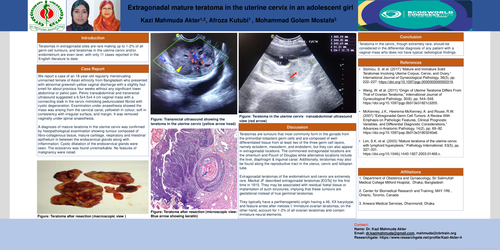
We report a case of an 18-year-old regularly menstruating unmarried female of Asian ethnicity from Bangladesh who presented with abnormal greenish-yellow vaginal discharge with a slightly foul smell for about previous four weeks without any significant lower abdominal or pelvic pain. Pelvic transabdominal and transrectal ultrasound suggested a 6.5x4.5x4.4 cm vaginal mass with a connecting stalk in the cervix mimicking pedunculated fibroid with cystic degeneration. Examination under anaesthesia showed the mass was arising from the cervical canal, yellowish in colour, soft in consistency with irregular surface, and margin. It was removed vaginally under spinal anaesthesia.
A diagnosis of mature teratoma in the uterine cervix was confirmed by histopathological examination showing tumour composed of fibro-collagenous tissue, mature cartilage, respiratory and intestinal epithelium in between the endocervical glands along with inflammation. Cystic dilatation of the endocervical glands were seen. The ectocervix was found unremarkable. No features of malignancy were noted.
Discussion:
Teratomas are tumours that most commonly form in the gonads from the primordial totipotent germ cells and are composed of well-differentiated tissue from at least two of the three germ cell layers, namely ectoderm, mesoderm, and endoderm, but they can also appear in extragonadal locations. The commonest extragonadal locations are the omentum and Pouch of Douglas while alternative locations include the liver, diaphragm & inguinal canal. Additionally, teratomas may also be found along the reproductive tract in the uterus, cervix and fallopian tube.
Extragonadal teratomas of the endometrium and cervix are extremely rare. Meckel JF described extragonadal teratomas [EGTs] for the first time in 1815. They may be associated with residual foetal tissue or implantation of such structures, implying that these tumours are gestational instead of true germinal teratomas.
They typically have a parthenogenetic origin having a 46, XX karyotype, and feature arrest after meiosis I. Immature ovarian teratomas, on the other hand, account for 1-2% of all ovarian teratomas and contain immature neural elements.
Conclusions:
Teratoma in the cervix, though extremely rare, should be considered in the differential diagnosis of any patient with a vaginal mass who does not have typical radiological findings.
Keywords: Vaginal mass, extragonadal, mature teratoma, Cervix