1,830 posters, 67 videos, 75 audios, 29 topics, 22 sessions, 4,727 authors, 1,697 institutions
ePostersLive by SciGen Technologies S.A. All rights reserved.
RCOG World Congress 2023
June 12 - 14, 2023 | London, UK

EP.0341
Obstructed Hemi-Vagina with Ipsilateral Renal Agenesis causing Pelvic Inflammatory Disease
Poster Presenter
Authors
Affiliations
Part of Topic
Adolescent Gynaecology
Abstract Title
Obstructed Hemi-Vagina with Ipsilateral Renal Agenesis causing Pelvic Inflammatory Disease
Objective
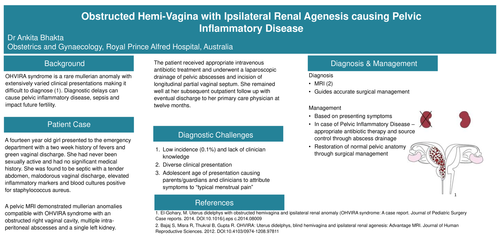
OHVIRA syndrome is a rare mullerian anomaly with extensively varied clinical presentations making it difficult to diagnose. Diagnostic delays can cause pelvic inflammatory disease, sepsis and impact future fertility.
Case Report
A fourteen year old girl presented to the emergency department with a two week history of fevers and green vaginal discharge. She had never been sexually active and had no significant medical history. She was found to be septic with a tender abdomen, malodorous vaginal discharge, elevated inflammatory markers and blood cultures positive for staphylococcus aureus. A pelvic MRI demonstrated mullerian anomalies compatible with OHVIRA syndrome with an obstructed right vaginal cavity, multiple intra-peritoneal abscesses and a single left kidney. The patient received appropriate intravenous antibiotic treatment and underwent a laparoscopic drainage of pelvic abscesses and incision of longitudinal partial vaginal septum. She remained well at her subsequent outpatient follow up with eventual discharge to her primary care physician at twelve months.
Discussion
OHVIRA syndrome is a mullerian anomaly characterised by uterine didelphys, ipsilateral renal agenesis and obstructed hemivagina. The presentations of this syndrome are varied, though typically present in the post-pubertal phase.
The difficulty of diagnosis is multifactorial, stemming from the low incidence estimated to be 0.1% and subsequent clinician unawareness, the diverse clinical presentation and the age of the patients at presentation often leading to guardians and clinicians attributing symptoms to expected menstrual pain. Delays to diagnosis can significantly impact the quality of life of patients, and in some cases lead to acute sepsis secondary to pelvic inflammatory disease necessitating emergency surgery, as in out case report.
Diagnosis of OHVIRA syndrome is confirmed on imaging and typically an MRI is required to guide accurate surgical management.
There needs to be an increase in clinician awareness of the syndrome, particularly in primary care doctors, emergency department physicians as well as renal and adolescent gynaecologists. The aim should be to detect the presence of OHVIRA syndrome and proceed to surgical management to remove the obstructing vaginal septum to prevent complications of pyometra and preserve fertility.
Conclusions
OHVIRA syndrome can be associated with significant complications when there are delays to diagnosis and management. There is a need for increased clinician awareness and further case reports to capture the diverse potential presentations of this syndrome.