1,830 posters, 67 videos, 75 audios, 29 topics, 22 sessions, 4,727 authors, 1,697 institutions
ePostersLive by SciGen Technologies S.A. All rights reserved.
RCOG World Congress 2023
June 12 - 14, 2023 | London, UK

EP.0335
Laparoscopic drainage of post-caesarean section pelvic haematoma- A case report.
Poster Presenter
Authors
Affiliations
Part of Topic
Hot Topics (Emerging research/issues) in Obstetrics
Objective: We describe a case of right sided broad ligament haematoma following Caesarean section which was managed by laparoscopy and drainage.
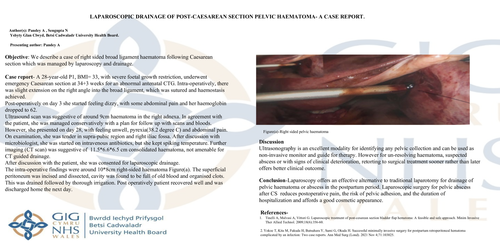
Case report- A 28-year-old P1, BMI= 33, with severe foetal growth restriction, underwent emergency Caesarean section at 34+3 weeks for an abnormal antenatal CTG. Intra-operatively, there was slight extension on the right angle into the broad ligament, which was sutured and haemostasis achieved. Post-operatively on day 3 she started feeling dizzy, with some abdominal pain and her haemoglobin dropped to 62. Ultrasound scan was suggestive of around 9cm haematoma in the right adnexa. In agreement with the patient, she was managed conservatively with a plan for follow up with scans and bloods. However, she presented on day 28, with feeling unwell, pyrexia(38.2 degree C) and abdominal pain. On examination, she was tender in supra-pubic region and right iliac fossa. After discussion with microbiologist, she was started on intravenous antibiotics, but she kept spiking temperature. Further imaging (CT scan) was suggestive of 11.5*6.6*6.5 cm consolidated haematoma, not amenable for CT guided drainage. After discussion with the patient, she was consented for laparoscopic drainage. The intra-operative findings were around 10*8cm right-sided haematoma Figure(a). The superficial peritoneum was incised and dissected, cavity was found to be full of old blood and organised clots. This was drained followed by thorough irrigation. Post operatively patient recovered well and was discharged home the next day
Discussion Ultrasonography is an excellent modality for identifying any pelvic collection and can be used as non-invasive monitor and guide for therapy. However for un-resolving haematoma, suspected abscess or with signs of clinical deterioration, retorting to surgical treatment sooner rather than later offers better clinical outcome.
Conclusion-Laparoscopy offers an effective alternative to traditional laparotomy for drainage of pelvic haematoma or abscess in the postpartum period. Laparoscopic surgery for pelvic abscess after CS reduces postoperative pain, the risk of pelvic adhesion, and the duration of hospitalization and affords a good cosmetic appearance.