1,830 posters, 67 videos, 75 audios, 29 topics, 22 sessions, 4,727 authors, 1,697 institutions
ePostersLive by SciGen Technologies S.A. All rights reserved.
RCOG World Congress 2023
June 12 - 14, 2023 | London, UK

EP.0333
Diagnosis and Management of Gestational Trophoblastic Neoplasia with Lumbosacral Metastases
Part of Topic
Gynae Oncology
INTRODUCTION
Gestational trophoblastic neoplasia (GTN) refers to a group of malignancies from abnormal trophoblastic proliferation and includes invasive mole, choriocarcinoma, placental site trophoblastic tumor, and epithelioid trophoblastic tumor. GTN may develop after molar and non-molar pregnancies. In about 80% of cases, remote metastasis is already present upon the diagnosis of GTN. The most frequent sites of metastases are the lungs, vagina, pelvis, and liver. Ten percent of metastatic GTN involve the central nervous system, and metastasis to the brain is generally considered a poor prognostic factor. Spinal cord metastasis is even more infrequent, with only 18 documented case reports in literature as of writing of this case report. A standardized treatment regimen for patients with central nervous system metastasis has not been established because of its rarity.
INDEX CASE
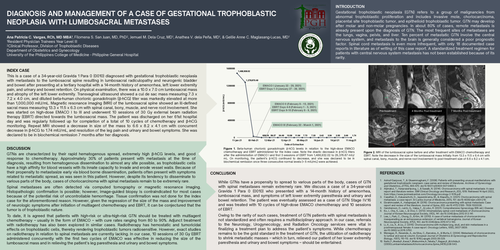
This is a case of a 34-year-old Gravida 1 Para 0 (0010) diagnosed with gestational trophoblastic neoplasia with metastasis to the lumbosacral spine resulting in lumbosacral radiculopathy and neurogenic bladder and bowel after presenting at a tertiary hospital with a 14-month history of amenorrhea, left lower extremity pain, and urinary and bowel retention. On physical examination, there was a 10.0 x 7.0 cm lumbosacral mass and atrophy of the left lower extremity. Transvaginal ultrasound showed a cul de sac mass measuring 7.3 x 7.2 x 4.0 cm, and diluted beta-human chorionic gonadotropin (β-hCG) titer was markedly elevated at more than 1,000,000 mIU/mL. Magnetic resonance imaging (MRI) of the lumbosacral spine showed an ill-defined sacral mass measuring 13.3 x 11.5 x 6.3 cm with spinal canal, bony, muscle, and nerve root involvement. She was started on high-dose EMACO I to III and underwent 10 sessions of 30 Gy external beam radiation therapy (EBRT) directed towards the lumbosacral mass. The patient was discharged on her 61st hospital day and was regularly followed up for completion of a total of 10 cycles of chemotherapy and β-hCG monitoring. Repeat MRI showed a decrease in size of the mass to 6.6 x 8.2 x 4.1 cm with concurrent decrease in β-hCG to 1.74 mIU/mL, and resolution of the leg pain and urinary and bowel symptoms. She was declared to be in biochemical remission 7 months after her diagnosis.
DISCUSSION
GTNs are characterized by their rapid hematogenous spread, extremely high β-hCG levels, and good response to chemotherapy. Approximately 30% of patients present with metastasis at the time of diagnosis, resulting from hematogenous dissemination to almost any site possible, as trophoblastic cells have a high affinity for blood vessels with its innate capacity to invade and erode vessel walls. Because of their propensity to metastasize early via blood borne dissemination, patients often present with symptoms related to metastatic spread, as was seen in this patient. However, despite its tendency to disseminate to various parts of the body, cases of choriocarcinoma with spinal metastasis remain to be extremely rare.
Spinal metastases are often detected via computed tomography or magnetic resonance imaging. Histopathologic confirmation is possible; however, image-guided biopsy is contraindicated for most cases because of the potential risk of uncontrollable hemorrhage. Tissue confirmation was not done for the index case for the aforementioned reason. However, given the regression of the size of the mass and improvement of neurologic symptoms after initiation of multiagent chemotherapy and EBRT, it can be conjectured that the tumor is of trophoblastic nature.
To date, it is agreed that patients with high-risk or ultra-high-risk GTN should be treated with multiagent chemotherapy – usually in the form of EMACO – with cure rates ranging from 80 to 90%. Adjunct treatment with radiotherapy has also been explored in similar cases. Radiotherapy has hemostatic and tumoricidal effects on trophoblastic cells, thereby rendering trophoblastic tumors radiosensitive. However, exact studies on radiotherapy in relation to spinal metastasis are currently lacking. In our case, 10 sessions of 30 Gy EBRT administered concurrently with the first two cycles of EMACO was effective in reducing the size of the lumbosacral mass and in relieving the patient’s leg paresthesia and urinary and bowel symptoms.
CONCLUSION
While GTNs have a propensity to spread to various parts of the body, cases of GTN with spinal metastases remain extremely rare. We discuss a case of a 34-year-old Gravida 1 Para 0 (0010) who presented with a 14-month history of amenorrhea, lumbosacral mass, and symptoms of left lower extremity paresthesia and urinary and bowel retention. The patient was eventually assessed as a case of GTN Stage IV:16 and was treated with 10 cycles of high-dose EMACO chemotherapy and 10 sessions of EBRT.
Owing to the rarity of such cases, treatment of GTN patients with spinal metastasis is not standardized and often requires a multidisciplinary approach. In our case, referrals to the Neurology, Urogynecology, and Radiation Oncology services were vital in finalizing a treatment plan to address the patient’s symptoms. While chemotherapy remains to be the gold standard in the treatment of GTN, the utilization of radiotherapy to shrink metastatic masses – which in turn, relieved our patient of her lower extremity paresthesia and urinary and bowel symptoms – should be entertained.