1,830 posters, 67 videos, 75 audios, 29 topics, 22 sessions, 4,727 authors, 1,697 institutions
ePostersLive by SciGen Technologies S.A. All rights reserved.
RCOG World Congress 2023
June 12 - 14, 2023 | London, UK

EP.0326
Focal Atrial Tachycardia in pregnancy - An Enigmatic challenge for the Obstetrician
Poster Presenter
Part of Topic
High Risk Pregnancy
Audio
Focal Atrial Tachycardia in pregnancy: An Enigmatic challenge for the Obstetrician
Introduction
Case Report
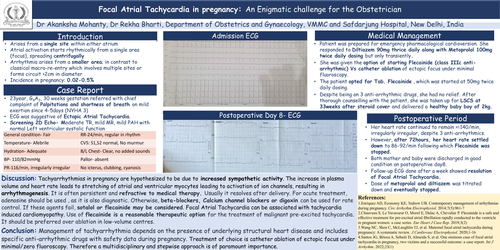
Discussion: Tachyarrhythmias in pregnancy are hypothesized to be due to increased sympathetic activity. The increase in plasma volume and heart rate leads to stretching of atrial and ventricular myocytes leading to activation of ion channels, resulting in arrhythmogenesis. It is often persistent and refractive to medical therapy. Usually it resolves after delivery. For acute treatment, adenosine should be used , as it is also diagnostic. Otherwise, beta-blockers, Calcium channel blockers or digoxin can be used for rate control. If these agents fail, sotalol or flecainide may be considered. Focal Atrial Tachycardia can be associated with tachycardia induced cardiomyopathy. Use of flecainide is a reasonable therapeutic option for the treatment of malignant pre-excited tachycardia. It should be preferred over ablation in low-volume centres.
Conclusion: Management of tachyarrhythmia depends on the presence of underlying structural heart disease and includes specific anti-arrhythmic drugs with safety data during pregnancy. Treatment of choice is catheter ablation of ectopic focus under minimal/zero fluoroscopy. Therefore a multidisciplinary and stepwise approach is of paramount importance.
References:
1.Enriquez AD, Economy KE, Tedrow UB. Contemporary management of arrhythmias during pregnancy. Circ Arrhythm Electrophysiol. 2014;7(5):961-7
2.Chauveau S, Le Vavasseur O, Morel E, Dulac A, Chevalier P. Flecainide is a safe and effective treatment for pre-excited atrial fibrillation rapidly conducted to the ventricle in pregnant women: a case series. Eur Heart J Case Rep. 2019;3(2)
3.Wang NC, Shen C, McLaughlin TJ, et al. Maternal focal atrial tachycardia during pregnancy: A systematic review. J Cardiovasc Electrophysiol. 2020;1-16
4.Santos JG, Briosa A, Sebaiti D, Almeida S, et al. One ominous case of focal atrial tachycardia in pregnancy, two victims and a successful outcome: a case report. Int J Arrhythm. 2022;23(1)