1,830 posters, 67 videos, 75 audios, 29 topics, 22 sessions, 4,727 authors, 1,697 institutions
ePostersLive by SciGen Technologies S.A. All rights reserved.
RCOG World Congress 2023
June 12 - 14, 2023 | London, UK

EP.0318
A rare case of acquired hemophilia in pregnancy
Poster Presenter
Part of Topic
High Risk Pregnancy
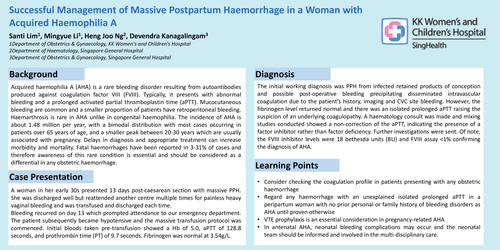
Successful Management of Massive Postpartum Haemorrhage in a Woman with Acquired Haemophilia A
Acquired haemophilia A (AHA) is a rare bleeding disorder resulting from autoantibodies produced against coagulation factor VIII (FVIII). Typically, it presents with abnormal bleeding and a prolonged activated partial thromboplastin time (aPTT). Mucocutaneous bleeding are common and a smaller proportion of patients have retroperitoneal bleeding. Haemarthrosis is rare in AHA unlike in congenital haemophilia. The incidence of AHA is about 1.48 million per year, with a bimodal distribution with most cases occurring in patients over 65 years of age, and a smaller peak between 20-30 years which are usually associated with pregnancy. Delays in diagnosis and appropriate treatment can increase morbidity and mortality. Fatal haemorrhages have been reported in 3-31% of cases and therefore awareness of this rare condition is essential and should be considered as a differential in any obstetric haemorrhage.
A woman in her early 30s presented 13 days post-caesarean section with massive PPH. She was discharged well but reattended another centre multiple times for painless heavy vaginal bleeding and was transfused and discharged each time. Bleeding recurred on day 13 which prompted attendance to our emergency department. The patient subsequently became hypotensive and the massive transfusion protocol was commenced. Initial bloods taken pre-transfusion showed a Hb of 5.0, aPTT of 128.8 seconds, and prothrombin time (PT) of 9.7 seconds. Fibrinogen was normal at 3.54g/L.
The initial working diagnosis was PPH from infected retained products of conception and possible post-operative bleeding precipitating disseminated intravascular coagulation due to the patient’s history, imaging and CVC site bleeding. However, the fibrinogen level returned normal and there was an isolated prolonged aPTT raising the suspicion of an underlying coagulopathy. A haematology consult was made and mixing studies conducted showed a non-correction of the aPTT, indicating the presence of a factor inhibitor rather than factor deficiency. Further investigations were sent. Of note, the FVIII inhibitor levels were 18 bethesda units (BU) and FVIII assay <1% confirming the diagnosis of AHA.