1,830 posters, 67 videos, 75 audios, 29 topics, 22 sessions, 4,727 authors, 1,697 institutions
ePostersLive by SciGen Technologies S.A. All rights reserved.
RCOG World Congress 2023
June 12 - 14, 2023 | London, UK

EP.0311
Chronic Myeloid Leukemia in Pregnancy: 20 years’ experience in tertiary care center
Poster Presenter
Authors
Hiba Arshad Shaikh, Warda Maqsood, Lumaan Sheikh, Atiya Khalid
Affiliations
Part of Topic
High Risk Pregnancy
TITLE:
Chronic Myeloid Leukemia in Pregnancy: 20 years’ experience in a tertiary care center
OBECTIVE:
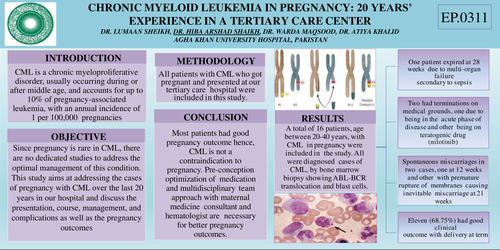
CML is a chronic myeloproliferative disorder that usually occurs during or after middle age. CML accounts for up to 10% of pregnancy-associated leukemia, with an annual incidence of 1 per 100,000 pregnancies. Since pregnancy is rare in CML, there are no dedicated studies to address the optimal management of this condition. This study aims at addressing the cases of pregnancy with CML over the last 20 years in our hospital and discuss the presentation, course, management, and complications as well as the pregnancy outcomes.
DESIGN:
Retrospective cross-sectional study to include all the cases that presented at our tertiary care hospital.
METHOD:
All patients with CML who got pregnant were included in this study. Data was retrieved through the hospital information management system and was recorded on a pre-structured questionnaire.
RESULTS:
A total of 16 patients,age between 20-40 years, with CML in pregnancy were included in the study. All were diagnosed cases of CML, by bone marrow biopsy showing ABL-BCR translocation. Majority patients, before conceiving were under treatment in the remission phase of disease, only one patient being diagnosed in the 8th month of pregnancy. Among these, one patient expired after 7 months of delivery (at 28 weeks pregnancy) due to multi-organ failure due to sepsis. Of the remaining patients, 2 had terminations on medical grounds, one due to being in the acute phase of disease and other being on teratogenic drug (nilotinib). Two pregnancies landed up in spontaneous miscarriages, one at 12 weeks gestation and other with premature rupture of membranes leading to inevitable miscarriage at 21 weeks. Rest of the 11 patients had good clinical outcome with delivery at term. Most of the patients were on tyrosine kinase inhibitor (Imatinib), started in the second trimester to avoid fetal teratogenicity in the first trimester. However, two of these patients developed intrauterine growth retardation (IUGR) while being on imatinib. Regular antenatal follow up with maternal medicine consultant and consultant hematologist were planned during the pregnancy. Adjustment of dosage of medication was made by having regular complete blood counts.
CONCLUSION:
Most of the patients had good pregnancy outcome despite having CML. Therefore, CML is not a contraindication to pregnancy. But pre-conception optimization of medication and multidisciplinary team approach with maternal medicine consultant and hematologist are necessary for better pregnancy outcomes.