1,830 posters, 67 videos, 75 audios, 29 topics, 22 sessions, 4,727 authors, 1,697 institutions
ePostersLive by SciGen Technologies S.A. All rights reserved.
RCOG World Congress 2023
June 12 - 14, 2023 | London, UK

EP.0309
Identification of variation in ultrasound operator skill levels in obese pregnant women
Poster Presenter
Authors
Affiliations
Part of Topic
Obesity
Aim: To identify variation in operator skill levels and impact on the level of interventions, and to identify any missed opportunities to intervene in morbidly obese pregnant women with no other comorbidities at booking.
Growth assessments on all pregnant mothers are undertaken by ultrasonographers in UK except in Northern Ireland where the medical team undertake all such assessments.
Considering the higher chance of suboptimal visualisation, estimating fetal weight can be challenging in obese mothers. Variation in the level of skills among trainees can further contribute to the errors in calculating EFW leading to unnecessary interventions as well as adverse outcomes due to missed SGA.
Method: 19 P0 with BMI >40 with no other comorbidities at booking during the year 2020 at a tertiary care unit in Northern Ireland were identified through Electronic Record and their maternity notes were reviewed to collate data.
Results
-
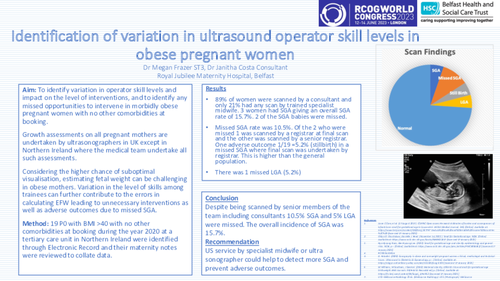
89% of women were scanned by a consultant and only 21% had any scan by trained specialist midwife. 3 women had SGA giving an overall SGA rate of 15.7%. 2 of the SGA babies were missed.
-
Missed SGA rate was 10.5%. Of the 2 who were missed 1 was scanned by a registrar at final scan and the other was scanned by a senior registrar. One adverse outcome 1/19 =5.2% (stillbirth) in a missed SGA where final scan was undertaken by registrar. This is higher than the general population.
-
There was 1 missed LGA (5.2%)
Conclusion
Despite being scanned by senior members of the team including consultants 10.5% SGA and 5% LGA were missed. The overall incidence of SGA was 15.7%.
Recommendation
US service by specialist midwife or ultra sonographer could help to detect more SGA and prevent adverse outcomes.