1,830 posters, 67 videos, 75 audios, 29 topics, 22 sessions, 4,727 authors, 1,697 institutions
ePostersLive by SciGen Technologies S.A. All rights reserved.
RCOG World Congress 2023
June 12 - 14, 2023 | London, UK

EP.0301
Managing IVF cycles to minimise OHSS in a public hospital fertility clinic
Poster Presenter
Authors
Affiliations
Part of Topic
Reproductive Medicine/Assisted Reproduction
Managing IVF cycles to minimise OHSS in a public hospital fertility clinic
I Robertson, A Umranikar, P Ford 1. Salisbury Fertility Centre, Salisbury, UK
Aim
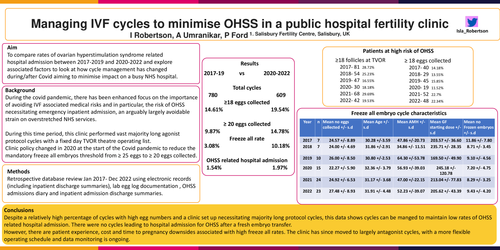
To compare rates of ovarian hyperstimulation syndrome and hospital admission between 2017-2019 and 2020-2022 and explore associated factors to look at how cycle management has changed during/after Covid aiming to minimise impact on a busy NHS hospital.
Background
During the covid pandemic, there has been enhanced focus on the importance of avoiding IVF associated medical risks and in particular, the risk of OHSS necessitating emergency inpatient admission, an arguably largely avoidable strain on overstretched NHS services.
During this time period, this clinic performed vast majority long agonist protocol cycles with a fixed day TVOR theatre operating list.
Clinic policy changed in 2020 at the start of the Covid pandemic to reduce the mandatory freeze all embryos threshold from ≥ 25 eggs to ≥ 20 eggs collected.
Methods
Retrospective database review Jan 2017- Dec 2022 using electronic records (including inpatient discharge summaries), lab egg log documentation , OHSS admissions diary and inpatient admission discharge summaries.
Conclusions
Despite a relatively high percentage of cycles with high egg numbers and a clinic set up necessitating majority long protocol cycles, this data shows cycles can be manged to maintain low rates of OHSS related hospital admission. There were no cycles leading to hospital admission for OHSS after a fresh embryo transfer.
However, there are patient experience, cost and time to pregnancy downsides associated with high freeze all rates. The clinic has since moved to largely antagonist cycles, with a more flexible operating schedule and data monitoring is ongoing.