1,830 posters, 67 videos, 75 audios, 29 topics, 22 sessions, 4,727 authors, 1,697 institutions
ePostersLive by SciGen Technologies S.A. All rights reserved.
RCOG World Congress 2023
June 12 - 14, 2023 | London, UK

EP.0284
The sFlT-1/PlGF Ratio - Should it make Obstetricians sweat?
Poster Presenter
Part of Topic
High Risk Pregnancy
SflT-1:PlGF Ratio - Does it make Obstetricians sweat?
Priyanka Phatak, Thorsten Fischer, Gerhard Bogner, Claudius Fazelnia, Michaela Duggan-Peer
University Hospital Salzburg, Department of Obstetrics & Gynaecology, Salzburg, Austria
Objective - Soluble fms-like tyrosine kinase 1 (sFlt-1) & placental growth factor (PlGF) are two anti-angiogenic & pro-angiogenic factors respectively measured in maternal serum. Their ratio is supposed to help diagnose or predict pre-eclampsia & placental dysfunction. This case report allows a retrospective study of the course of two pregnancies with very high Ratio values at presentation & their outcomes.
Case Report - We present 2 cases with very early onset pre-eclampsia & high sFlt-1:PlGF ratios, where we were able to prolong the pregnancies under careful monitoring till an optimum time for delivery.
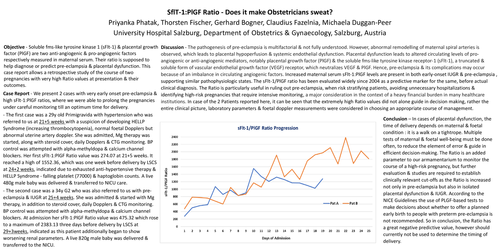
- The first case was a 29y old Primigravida with hypertension who was referred to us at 21+5 weeks with a suspicion of developing HELLP Syndrome (increasing thrombocytopenia), normal foetal Dopplers but abnormal uterine artery doppler. She was admitted, Mg therapy was started, along with steroid cover, daily Dopplers & CTG monitoring. BP control was attempted with alpha-methyldopa & calcium channel blockers. Her first sFlt-1:PlGF Ratio value was 274.07 at 21+5 weeks. It reached a high of 1552.36, which was one week before delivery by LSCS at 24+2 weeks, indicated due to exhausted anti-hypertensive therapy & HELLP Syndrome - falling platelet (77000) & haptoglobin counts. A live 480g male baby was delivered & transferred to NICU care.
- The second case was a 34y G2 who was also referred to us with pre-eclampsia & IUGR at 25+4 weeks. She was admitted & started with Mg therapy, in addition to steroid cover, daily Dopplers & CTG monitoring. BP control was attempted with alpha-methyldopa & calcium channel blockers. At admission her sFlt-1:PlGF Ratio value was 475.32 which rose to a maximum of 2383.13 three days before delivery by LSCS at 29+3weeks, indicated as this patient additionally began to show worsening renal parameters. A live 820g male baby was delivered & transferred to the NICU.
Discussion - The pathogenesis of pre-eclampsia is multifactorial & not fully understood. However, abnormal remodelling of maternal spiral arteries is observed, which leads to placental hypoperfusion & systemic endothelial dysfunction. Placental dysfunction leads to altered circulating levels of pro-angiogenic or anti-angiogenic mediators, notably placental growth factor (PlGF) & the soluble fms-like tyrosine kinase receptor-1 (sFlt-1), a truncated & soluble form of vascular endothelial growth factor (VEGF) receptor, which neutralizes VEGF & PlGF. Hence, pre-eclampsia & its complications may occur because of an imbalance in circulating angiogenic factors. Increased maternal serum sFlt-1:PlGF levels are present in both early-onset IUGR & pre-eclampsia , supporting similar pathophysiologic states. The sFlt-1/PlGF ratio has been evaluated widely since 2004 as a predictive marker for the same, before actual clinical diagnosis. The Ratio is particularly useful in ruling out pre-eclampsia, when risk stratifying patients, avoiding unnecessary hospitalizations & identifying high-risk pregnancies that require intensive monitoring, a major consideration in the context of a heavy financial burden in many healthcare institutions. In case of the 2 Patients reported here, it can be seen that the extremely high Ratio values did not alone guide in decision making, rather the entire clinical picture, laboratory parameters & foetal doppler measurements were considered in choosing an appropriate course of management
Conclusion – In cases of placental dysfunction, the time of delivery depends on maternal & foetal condition : it is a walk on a tightrope. Multiple tests of maternal & foetal well-being must be done often, to reduce the element of error & guide in efficient decision-making. The Ratio is an added parameter to our armamentarium to monitor the course of a high-risk pregnancy, but further evaluation & studies are required to establish clinically relevant cut-offs as the Ratio is increased not only in pre-eclampsia but also in isolated placental dysfunction & IUGR. According to the NICE Guidelines the use of PLGF-based tests to make decisions about whether to offer a planned early birth to people with preterm pre-eclampsia is not recommended. So in conclusion, the Ratio has a great negative predictive value, however should currently not be used to determine the timing of delivery.