1,830 posters, 67 videos, 75 audios, 29 topics, 22 sessions, 4,727 authors, 1,697 institutions
ePostersLive by SciGen Technologies S.A. All rights reserved.
RCOG World Congress 2023
June 12 - 14, 2023 | London, UK

EP.0283
An atypical case of amniotic fluid embolism in labour
Poster Presenter
Authors
Affiliations
Part of Topic
Labour Ward Management
An atypical case of amniotic fluid embolism in the second stage of labour
1. Introduction
Amniotic fluid embolism (AFE) is rare but widely known as a catastrophic and often lethal complication of childbirth. We describe a case of a young mother who made a remarkable full recovery a mere 7 days after suffering from multiple cerebral infarction due to AFE in labour.
2. Case study
Our patient was a 24-year-old with no medical problem and a low-risk pregnancy antenatally. She underwent an elective induction of labour at 39 weeks of gestation and went into active labour after 14 hours of controlled- release dinoprostone vaginal insert. An amniotomy was performed following removal of the insert. Thirty minutes later, fetal bradycardia was noted. At the same time, she started having convulsion followed by stupor with no cardiorespiratory arrest. Vaginal examination performed at this stage revealed a fully dilated cervix with the fetus at direct OP position at +1 station.
3. Clinical course
Forceps delivery was performed with good neonatal outcome. Unfortunately, the mother had stormy postpartum course with three litres of postpartum haemorrhage, which was eventually secured after uterine artery embolisation. During her stay in the intensive care unit (ICU), she was found to have classic features of right hemispheric syndrome; her response to painful stimuli was weaker on the left side of her body with persistent right gaze deviation.
4. Investigations
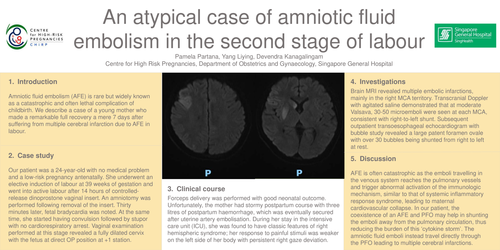
Brain MRI revealed multiple embolic infarctions, mainly in the right MCA territory. Transcranial Doppler with agitated saline demonstrated that at moderate Valsava, 30-50 microemboli were seen at each MCA, consistent with right-to-left shunt. Subsequent outpatient transoesophageal echocardiogram with bubble study revealed a large patent foramen ovale with over 30 bubbles being shunted from right to left at rest.
5. Discussion
AFE is often catastrophic as the emboli travelling in the venous system reaches the pulmonary vessels and trigger abnormal activation of the immunologic mechanism, similar to that of systemic inflammatory response syndrome, leading to maternal cardiovascular collapse. In our patient, the coexistence of an AFE and PFO may help in shunting the emboli away from the pulmonary circulation, thusreducing the burden of this ‘cytokine storm’. Theamniotic fluid emboli instead travel directly through the PFO leading to multiple cerebral infarctions.