1,830 posters, 67 videos, 75 audios, 29 topics, 22 sessions, 4,727 authors, 1,697 institutions
ePostersLive by SciGen Technologies S.A. All rights reserved.
RCOG World Congress 2023
June 12 - 14, 2023 | London, UK

EP.0275
Intensive Antenatal Monitoring and Pregnancy Outcomes after Previous Perinatal Deaths in Nigeria
Part of Topic
High Risk Pregnancy
Video
Intensive Antenatal Monitoring and Pregnancy Outcomes after Previous Perinatal Deaths in Nigeria.
Awowole I.O, Ubom A.E, Adeniyi O.A, Ameen M.O, Allen O.O, Ugowe J.O, Anyabolu H.C.
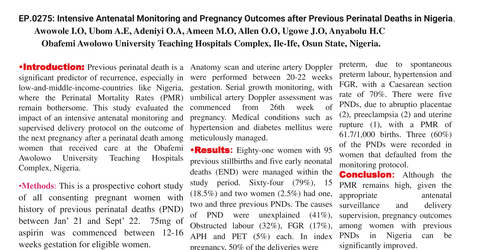
Objective: To achieve the SDG target 3.2 of ending preventable neonatal and under-5 deaths, appropriate care must be rendered to women at high risk of adverse perinatal outcomes. Previous perinatal death is a significant predictor of recurrence, especially in low-and-middle-income-countries like Nigeria, where the Perinatal Mortality Rates (PMR) remain bothersome. This study evaluated the impact of an intensive antenatal monitoring and supervised delivery protocol on the outcome of the next pregnancy after a perinatal death among women that received care at the Obafemi Awolowo University Teaching Hospitals Complex, Nigeria.
Study design: A prospective cohort study
Method: All consenting pregnant women with history of previous perinatal deaths (PND) were recruited between January 2021 and September 2022. For eligible women after risk assessment, 75mg of aspirin was commenced between 12-16 weeks gestation. Anatomy scan and uterine artery Doppler were performed between 20-22 weeks gestation. Serial growth monitoring, with umbilical artery Doppler assessment was commenced from 26th week of pregnancy. Medical conditions such as hypertension and diabetes mellitus were meticulously managed.
Result: Eighty-one women aged 23-45 years reported 100 previous PNDs, comprising 95 stillbirths and five early neonatal deaths (END) within the study period. Sixty-four (79%), 15 (18.5%) and two women (2.5%) had one, two and three previous PNDs, respectively. The mean gestational age (GA) at delivery in the pregnancies with PND was 35.5 ± 4.2 weeks. Forty-one (41%) PNDs were unexplained, 32 (32%) were due to prolonged obstructed labour, while five (5%) each were related to antepartum haemorrhage (APH) and preeclampsia. Of the 100 PNDs, seventy (70%) were hospital-based deliveries. The mean GA at booking in the index pregnancy was 19.4 6.4weeks, while the mean GA at delivery was 35.4 4.8weeks, with a mean birthweight of 2605 0.7g. Fifty (50%) of the babies were delivered preterm due to spontaneous preterm labour, hypertension and fetal growth restriction, with a Caesarean section rate of 70%. There were five PNDs, associated with abruptio placentae (2), severe preeclampsia (2) and uterine rupture (1), with a PMR of 61.7/1,000 births. Three (60%) of the PNDs were recorded in women that defaulted from the monitoring protocol.
Conclusion: Although the PMR remains high, given the appropriate antenatal surveillance and delivery supervision, pregnancy outcomes among women with previous PNDs in Nigeria can be significantly improved.