1,830 posters, 67 videos, 75 audios, 29 topics, 22 sessions, 4,727 authors, 1,697 institutions
ePostersLive by SciGen Technologies S.A. All rights reserved.
RCOG World Congress 2023
June 12 - 14, 2023 | London, UK

EP.0271
3-year retrospective observational study on association between low PAPP-A and pregnancy outcomes
Poster Presenter
Authors
Affiliations
Part of Topic
Fetal Medicine
3-YEAR RETROSPECTIVE OBSERVATIONAL STUDY ON ASSOCIATION BETWEEN LOW PAPP-A AND PREGNANCY OUTCOMES
By: Shriya Varghese, Ayesha Ahmad and Hiran Samarage
Northwick Park Hospital, London, United Kingdom.
1. Introduction:
Pregnancy-associated plasma protein-A (PAPP-A) is a glycoprotein produced by the placental syncytiotrophoblast, which has key roles in foetal growth promotion and maintenance of placental health. PAPP-A is a well-established marker used in the NHS combined screening programme for the detection of first trimester trisomies. Increasing evidence in literature has shown low levels of PAPP-A to be associated with a greater risk of adverse outcomes such as foetal growth restriction, preterm labour, pre eclampsia and stillbirths.
2. Objective:
The aim of our study was to assess the link between low PAPP-A levels and the development of small for gestational age (SGA) babies and foetal growth restriction (FGR) in our patient cohort.
3. Design and Methods:
Retrospective observational study on all pregnancies booked at our hospital from 1st January 2019 to 31st December 2021 who were found to have a PAPP-A level ≤ 0.4 MoM (≤5th centile). 12,882 women delivered after 24 weeks at our hospital. Following exclusion criteria, 448 women were found to have low PAPP-A. Exclusion criteria included miscarriages, terminations and unavailability of follow-up. Data on maternal demographics, BMI, parity, previous birth weights, smoking status, hypertension, gestation at delivery, mode of delivery, birthweight, Apgar scores, and admission to neonatal unit was recorded. Data was collected through CMiS maternity electronic system, anonymised and collated on Excel.
4. Results and Analysis:
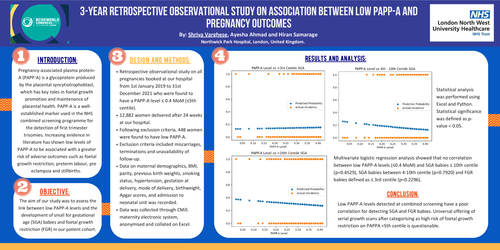
Statistical analysis was performed using Excel and Python. Statistical significance was defined as p-value < 0.05. Multivariate logistic regression analysis showed that no correlation between low PAPP-A levels (≤0.4 MoM) and SGA babies ≤ 10th centile (p=0.4529), SGA babies between 4-10th centile (p=0.7920) and FGR babies defined as ≤ 3rd centile (p=0.2296).
5. Conclusion:
Low PAPP-A levels detected at combined screening have a poor correlation for detecting SGA and FGR babies. Universal offering of serial growth scans after categorising as high risk of foetal growth restriction on PAPPA <5th centile is questionable.