1,830 posters, 67 videos, 75 audios, 29 topics, 22 sessions, 4,727 authors, 1,697 institutions
ePostersLive by SciGen Technologies S.A. All rights reserved.
RCOG World Congress 2023
June 12 - 14, 2023 | London, UK

EP.0264
Perinatal outcomes of higher order cesarean deliveries- a cross-sectional review from Qatar
Poster Presenter
Part of Topic
High Risk Pregnancy
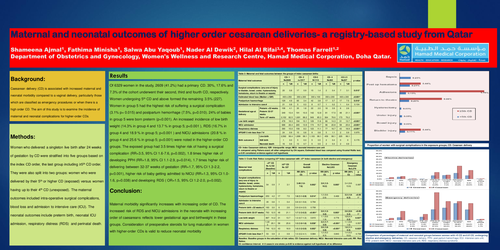
Maternal and neonatal outcomes of higher order cesarean deliveries a registry based study from Qatar
Background
Caesarean delivery (CD) is associated with increased maternal and neonatal morbidity compared to a vaginal delivery, particularly those which are classified as emergency procedures or when there is a high order CD. The aim of this study is to examine the incidence of maternal and neonatal complications for higher order CDs.
Methods:
Women who delivered a singleton live birth after 24 weeks of gestation by CD were stratified into five groups based on the index CD order, the last group including ≥5 th CD order. They were also split into two groups: women who were delivered by their 5 th or higher CD (exposed) versus women having up to their 4 th CD (unexposed). The maternal outcomes included intra operative surgical complications, blood loss and admission to intensive care (ICU). The neonatal outcomes include preterm birth, neonatal ICU admission, respiratory distress (RDS) and perinatal death.
Results
Of 6329 women in the study, 2609 (41.2%) had a primary CD. 30%, 17.6% and 7.3% of the cohort underwent their second, third and fourth CD, respectively. Women undergoing 5 th CD and above formed the remaining 3.5% (227). Women in group 5 had the highest risk of suffering a surgical complication (3.1% p= 0.015) and postpartum hemorrhage (7.5%, p=0.010). 24% of babies in group 5 were born preterm (p<0.001). An increased incidence of low birth weight (14.3% in group 4 and 13.7 % in group 5; p<0.001 ), RDS (16.7% in group 4 and 18.9 % in group 5; p<0.001 ) and NICU admissions (20.8 % in group 4 and 25.6 % in group 5; p<0.001) were noted in the higher order CD groups. The exposed group had 3.5 times higher risk of having a surgical complication (RR=3.5, 95% CI 1.6 7.6, p=0.002), 1.8 times higher risk of developing PPH (RR=1.8, 95% CI 1.1 2.9, p=0.014), 1.7 times higher risk of delivering between 32 37 weeks of gestation (RR=1.7, 95% CI 1.3 2.2, p<0.001), higher risk of baby getting admitted to NICU (RR=1.3, 95% CI 1.0-1.6, p=0.038) and developing RDS ( OR=1.5, 95% CI 1.2 2.0, p=0.002).
Conclusion:
Maternal morbidity significantly increases with increasing order of CD. The increased risk of RDS and NICU admissions in the neonate with increasing order of caesareans reflects lower gestational age and birthweight in these groups. Consideration of preoperative steroids for lung maturation in women with higher order CDs is valid to reduce neonatal morbidity.