1,830 posters, 67 videos, 75 audios, 29 topics, 22 sessions, 4,727 authors, 1,697 institutions
ePostersLive by SciGen Technologies S.A. All rights reserved.
RCOG World Congress 2023
June 12 - 14, 2023 | London, UK

EP.0263
A successful Partnership Experience of Trial of Labour After Cesarean Section Counseling
Poster Presenter
Authors
Renny Ully Ully, Salwa Alrawaili, Morounfolu Olaleye Thompson, Lolwa Alansari
Affiliations
Part of Topic
High Risk Pregnancy
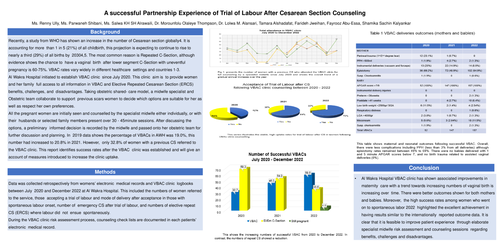
Recently, a study from WHO has shown an increase in the number of Cesarean section globally4. It is accounting for more than 1 in 5 (21%) of all childbirth, this projection is expecting to continue to rise to nearly a third (29%) of all births by 20304,5. The most common reason is Repeated C-Section, although evidence shows the chance to have a vaginal birth after lower segment C-Section with uneventful pregnancy is 60-75%. VBAC rates vary widely in different healthcare settings and countries 1-3.
Al Wakra Hospital initiated to establish VBAC clinic since July 2020. This clinic aim is to provide women and her family full access to all information in VBAC and Elective Repeated Cesarean Section (ERCS) benefits, challenges, and disadvantages. Taking obstetric shared- care model, a midwife specialist and Obstetric team collaborate to support previous scars women to decide which options are suitable for her as well as respect her own preferences.
All the pregnant women are initially seen and counselled by the specialist midwife either individually, or with their husbands or selected family members present over 30 - 45minute sessions. After discussing the options, a preliminary informed decision is recorded by the midwife and passed onto her obstetric team for further discussion and planning. In 2019 data shows the percentage of VBACs in AWH was 19.0%, this number had increased to 20.8% in 2021. However, only 32.8% of women with a previous CS referred to the VBAC clinic. This report identifies success rates after the VBAC clinic was established and will give an account of measures introduced to increase the clinic uptake.
METHOD:
Data was collected retrospectively from womens’ electronic medical records and VBAC clinic logbooks between July 2020 and December 2022 at Al Wakra Hospital. This included the numbers of women referred to the service, those accepting a trial of labour and mode of delivery after acceptance in those with spontaneous labour onset, number of emergency CS after trial of labour, and numbers of elective repeat CS (ERCS) where labour did not ensue spontaneously.
During the VBAC clinic risk assessment process, counseling check lists are documented in each patients’ electronic medical record.
CONCLUSION :