1,830 posters, 67 videos, 75 audios, 29 topics, 22 sessions, 4,727 authors, 1,697 institutions
ePostersLive by SciGen Technologies S.A. All rights reserved.
RCOG World Congress 2023
June 12 - 14, 2023 | London, UK

EP.0261
Efficacy and Safety of ‘CARBETOCIN’ in Prevention of Postpartum Hemorrhage
Poster Presenter
Authors
Affiliations
Part of Topic
Labour Ward Management
Audio
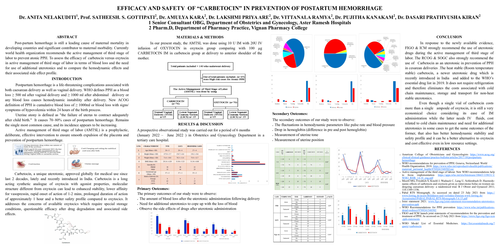
EFFICACY AND SAFETY OF “CARBETOCIN” IN PREVENTION OF POSTARTUM HEMORRHAGE
Dr. ANITA NELAKUDITI1, Prof. SATHEESH. S. GOTTIPATI2, Dr. AMULYA KARA2, Dr. LAKSHMI PRIYA ARE2, Dr. VITTANALA RAMYA2, Dr. PUJITHA KANAKAM2, Dr. DASARI PRATHYUSHA KIRAN2
1 Senior Consultant OBG, Department of Obstetrics and Gynecology, Aster Ramesh Hospitals 2 Pharm.D, Department of Pharmacy Practice, Vignan Pharmacy College
ABSTRACT
Post-partum hemorrhage is still a leading cause of maternal mortality in developing countries and significant contributor to maternal morbidity. Currently world health organization recommends the active management of third stage of labor to prevent atonic PPH. To assess the efficacy of carbetocin versus oxytocin in active management of third stage of labor in terms of blood loss and the need for use of additional uterotonics and to compare the hemodynamic effects and their associated side effect profile.
INTRODUCTION
Postpartum hemorrhage is a life-threatening complications associated with both caesarean delivery as well as vaginal delivery. WHO defines PPH as a blood loss ≥ 500 ml after vaginal delivery and ≥ 1000 ml after abdominal delivery or any blood loss causes hemodynamic instability after delivery. New ACOG definition of PPH is cumulative blood loss of ≥ 1000ml or blood loss with signs/ symptoms of hypovolemia within 24 hours of the birth process.
Uterine atony is defined as "the failure of uterus to contract adequately after child birth." It causes 70–80% cases of postpartum hemorrhage. Remains the single most common cause, and its incidence appears to be increasing.
Active management of third stage of labor (AMTSL) is a prophylactic, deliberate, effective intervention to ensure smooth expulsion of the placenta and prevention of postpartum hemorrhage.
Carbetocin, a unique uterotonic, approved globally for medical use since last 2 decades, lately and recently introduced in India. Carbetocin is a long acting synthetic analogue of oxytocin with agonist properties, molecular structure different from oxytocin can lead to enhanced stability, lower affinity for vasopressin, rapid onset of action of 1-2 mins, prolonged duration of action of approximately 1 hour and a better safety profile compared to oxytocics. It addresses the concerns of available oxytocics which require special storage conditions, questionable efficacy after drug degradation and associated side effects.
MATERIALS & METHODS
In our present study, the AMTSL was done using 10 U IM with 20U IV infusion of OXYTOCIN in oxytocin group comparing with 100 µg CARBETOCIN IM in carbetocin group at delivery to anterior shoulder of the mother.In our total study of 140, 70 cases of NVD and 70 of LSCS, the uterotonic drugs carbetocin (n=35) and oxytocin (n=35) were studied.Out of total 140, 45 women were categorized based on the risk for developing atonic PPH [eg: GDM – causing Polyhydramnios; Macrosomia; Multiple Pregnancy; Prolonged Labor; Prolonged PROM. Medical disorders peculiar to pregnancy eg: Gestational HTN, Pre-eclampsia, Eclampsia, HELLP syndrome, Abruptio Placenta, Placenta Previa, and IHCP. Medical disorders – Coagulopathy, Heart disease (Peripartum Cardiomyopathy, SVT), MARFAN syndrome with aortic arch dilatation with moderate MR, Bronchial Asthma], carbetocin (n=26) and oxytocin (n=19) were included
A prospective observational study was carried out for a period of 6 months
(January 2022 – June 2022 ) in Obstetrics and Gynecology Department in a tertiary care hospital.
Primary Outcomes:
The primary outcomes of our study were to observe:
- The amount of blood loss after the uterotonic administration following delivery
- Need for additional uterotonics to cope up with the loss of blood
- Observe the side effects of drugs after uterotonic administration
Secondary Outcomes:
The secondary outcomes of our study were to observe:
- The fluctuations in hemodynamic parameters like pulse rate and blood pressure
- Drop in hemoglobin (difference in pre and post hemoglobin)
- Measurement of uterine tone
- Measurement of uterine position
CONCLUSION
In response to the newly available evidence, FIGO & ICM strongly recommend the use of uterotonic drugs during the active management of third stage of labor. The RCOG & SOGC also strongly recommend the use of Carbetocin as an uterotonic in prevention of PPH in cesarean deliveries .The heat stable (Room temperature stable) carbetocin, a newer uterotonic drug which is recently introduced in India and added to the WHO’s essential drug list in 2019. It does not require refrigeration and therefore eliminates the costs associated with cold chain maintenance, storage and transport for non-heat stable uterotonics.
Even though a single vial of carbetocin costs more than a single ampoule of oxytocin, it is still a very economical choice considering its ease of IM administration while the latter needs IV fluids, cost related to cold chain maintenance and need for additional uterotonics in some cases to get the same outcomes of the former, that also has better hemodynamic stability and safety profile and it can be a better alternative to oxytocin and cost effective even in low resource settings.
REFERENCES
- American College of Obstetricians and Gynecologists https://www.acog.org/ clinical/clinical-guidance/practice-bulletin/articles/2017/10/postpartum- hemorrhage
- WHO recommendations for prevention of PPH. Geneva, Switzerland: World Health Organization; 2018. https://www.who.int/reproductivehealth/publications/ maternal_perinatal_health/9789241548502/en/
- Active management of the third stage of labour. New WHO recommendations help to focus implementation https://apps.who.int/iris/bitstream/10665/119831/1/ WHO_RHR_14.18_eng.pdf
- Moertl MG, Friedrich S, Krashl J, Wadsack C, Lang U, Schlembach D. Haemody- namic effects of carbetocin and oxytocin given as intravenous bolus on women un- dergoing caesarean delivery: a randomised trial. B J Obstet and Gynaecol 2011; 118:1349-1356.
- Pabal RTS Monograph. As accessed on dated 23 July 2021 from https:// www.ferring.de/assets/Bilddaten-und-verlinkte-Dateien-www.ferring.de/ Arzneimittel/PABAL/PABAL-RTS-Monograph-5.6.15.pdf
- Joint statement 2021. www.figo.org/joint-statement-recommendation-uterotonics- prevention-pph
- WHO Recommendations for PPH prevention https://www.who.int/publications- detail-redirect/9789241548502
- FIGO and ICM launch joint statements of recommendation for the prevention and treatment of PPH. As accessed on 23 July 2021 from https://www.figo.org/figo-icm
- WHO Model List of Essential Medicines. https://list.essentialmeds.org/? query=carbetocin