1,830 posters, 67 videos, 75 audios, 29 topics, 22 sessions, 4,727 authors, 1,697 institutions
ePostersLive by SciGen Technologies S.A. All rights reserved.
RCOG World Congress 2023
June 12 - 14, 2023 | London, UK

EP.0251
Clinical utility of Serum anti-Mullerian hormone in Polycystic Ovarian syndrome (PCOS) women
Poster Presenter
Authors
Rohitha Cheluvaraju, Reeta Mahey, Neena Malhotra, Monika Rajput
Affiliations
Part of Topic
Reproductive Medicine/Assisted Reproduction
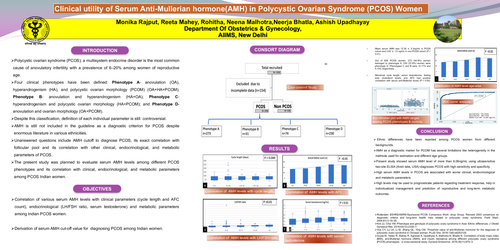
Anti-Mullerian hormone (AMH) is one of the direct indicators of follicular pool but no standard cutoff has been defined for diagnosis of polycystic ovary syndrome (PCOS). The present study evaluated the serum AMH levels among different PCOS phenotypes and correlated the AMH levels with clinical, hormonal, and metabolic parameters among Indian PCOS women. Mean serum AMH was 12.39 ± 5.3ng/mL in PCOS cohort and 3.83 ± 1.5 ng/mL in non-PCOS cohort (P < 0.01). Out of 608 PCOS women, 273 (44.9%) women belonged to phenotype A, 230 (37.8%) women were phenotype D. Phenotypes C and B were 12.17% and 5.10% respectively. Among those with the highest AMH group (AMH>20ng/ml; 8.05%), majority belonged to phenotype A. Menstrual cycle length, serum testosterone, fasting total cholesterol levels, and follicle number per ovary had positive correlation with serum anti-Mullerian levels (P < 0.05). AMH cutoff for the diagnosis of PCOS was calculated as ≥ 6.06 ng/mL on ROC analysis with sensitivity and specificity of 91.45% and 90.71% respectively. The study shows high serum AMH levels in PCOS are associated with worse clinical, endocrinological, and metabolic parameters. These levels may be used to counsel patients regarding treatment response, help in individualized management and predic- tion of reproductive and long-term metabolic outcomes.