1,830 posters, 67 videos, 75 audios, 29 topics, 22 sessions, 4,727 authors, 1,697 institutions
ePostersLive by SciGen Technologies S.A. All rights reserved.
RCOG World Congress 2023
June 12 - 14, 2023 | London, UK

EP.0250
Audit of the outcomes of treatment of iron deficiency anaemia with Monofer®.
Poster Presenter
Authors
Affiliations
Part of Topic
Maternal Medicine
Introduction:
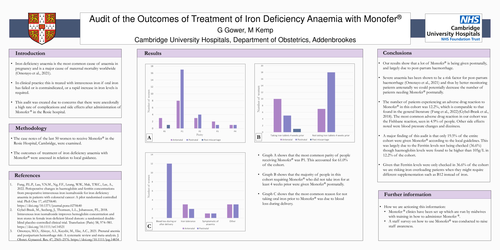
Iron deficiency anaemia is the most common cause of anaemia in pregnancy and is a major cause of maternal mortality worldwide (Omotayo et al., 2021). In clinical practice this is treated with intravenous iron if oral iron has failed or is contraindicated, or a rapid increase in iron levels is required. This audit was created due to concerns that there were anecdotally a high rate of complications and side effects after administration of Monofer ® in the Rosie hospital.
Methodology:
The case notes of the last 50 women to receive Monofer® in the Rosie Hospital, Cambridge, were examined. The outcomes of treatment of iron deficiency anaemia with Monofer® were assessed in relation to local guidance.
Conclusions:
Our results show that a lot of Monofer ® is being given postnatally, and largely due to post-partum haemorrhage. Severe anaemia has been shown to be a risk factor for post-partum haemorrhage (Omotayo et al., 2021) and thus by better monitoring patients antenatally we could potentially decrease the number of patients needing Monofer ® postnatally. The number of patients experiencing an adverse drug reaction to Monofer ® in this cohort was 12.2%, which is comparable to that found in the general literature (Fung et al., 2022)(Gybel-Brask et al., 2018). The most common adverse drug reaction in our cohort was the Fishbane reaction, seen in 4.9% of people. Other side effects noted were blood pressure changes and dizziness. A major finding of this audit is that only 19.5% of the entire cohort were given Monofer ® according to the local guidelines. This was largely due to the Ferritin levels not being checked (36.6%) though haemoglobin levels were found to be higher than 105g/L in 12.2% of the cohort. Given that Ferritin levels were only checked in 36.6% of the cohort we are risking iron overloading patients when they might require different supplementation such as B12 instead of iron.