Loading...

1,830 posters, 67 videos, 75 audios, 29 topics, 22 sessions, 4,727 authors, 1,697 institutions

ePostersLive by SciGen Technologies S.A. All rights reserved.

RCOG World Congress 2023

June 12 - 14, 2023 | London, UK

RCOG World Congress 2023 banner

EP.0247

Repeat cesarean section at 39 weeks or earlier, a 5-year study.
Part of Topic

Hot Topics (Emerging research/issues) in Obstetrics

Title: What is the right time to schedule a repeat cesareansection, before or after 39 weeks?  Five-year observation from a tertiary care hospital in a Middle Eastern country.

 Laxmi Saha, MahaAbdelwahab Ghoraba, Israa Sinan, Reham FathiHozayen, Priya Das 

Background:
A timely elective repeat caesarean section (ERCS) can be useful in reducing emergency caesarean sections (EmCS) and neonatal respiratory complications. The purpose of this study was to evaluate the outcome of repeat caesarean sections prior to and after 39 weeks.
 
Methodology:
This retrospective comparative study was conducted at King Hamad University Hospital, Bahrain. All scheduled term repeat CS from 2017 to 2021 were retrieved from the hospital records. Cases booked before 37 weeks, pregnancy with a congenital abnormal fetus, twin pregnancies, and incomplete information were excluded. The primary outcome was the frequency of elective and emergency CS between booked cases before and after 39 weeks of pregnancy was determined and compared.The secondary outcome included reasons for emergency CS, maternal and neonatal outcomes following CS done before and after 39 weeks of gestation were also determined and compared. A multivariate regression model was computed to evaluate the risk factors associated with spontaneous labour which was found main indication for emergency CS. All the statistical test was 2-tailed, and a p-value of <0.05 was considered significant.

Results: 
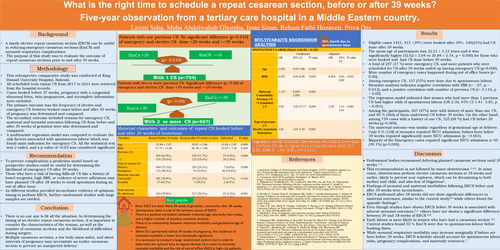
Eligible cases 1421, 415 (29%)were booked after 39%. 330(23%) had CS done after 39 weeks.
The mean age of participants was 32.21 ± 5.12 years and it was significantly higher (32.62 ± 5.04 vs 30.84 ± 5.14, p = 0.000) for those who were booked and had CS done before 39 weeks.
A total of 247 (17 %) were emergency CS, and more patients who were scheduled for CS after 39 weeks ended up having emergency CS (p=0.000).
More number of emergency cases happened during out of office hours (p= 0.00).
Among emergency CS, 137 (55%) were done due to spontaneous labour.
Bivariate analysis indicates negative correlation with BMI (r= -.07, p = 0.012), and a positive correlation with number of previous CS (r= 0.116, p = 0.00).
The regression model indicated that women who had more than 1 previous CS had higher odds of spontaneous labour (OR 2.36, 95% CI 1.41- 3.81, p = 0.001).
Among the participants, 667 (47%) were with history of more than one CS, and 85 % (566) of them underwent CS before 39 weeks. On the other hand, among 754 cases with a history of one CS, 525 (69 %) had CS before 39 weeks (p=0.000).
The maternal outcome was similar regardless of gestational age at delivery.
Only 9 % (128) of neonates required NICU admission; babies born before 39 weeks required significantly more NICU admission (p = 0.001).
The majority of the Emergency cases required significant NICU admission n=50 (39.1%) (p=0.000).

Discussion:
Professional bodies recommend deferring planned caesarean sections until 39 weeks 1,2. This recommendation is not followed by many obstetricians 3,4,5. In some cases, obstetricians perform elective caesarean sections at 38 weeks and earlier, likely to prevent scar ruptures, which can be devastating to both mother and child, and also fear of litigations6. Findings of neonatal and maternal morbidities following ERCS before and after 39 weeks were inconclusive. ERCS performed after 38 weeks did not show significant differences in maternal outcomes, similar to the current study5,6 while others found the opposite findings 4. Even though studies have shown ERCS before 39 weeks is associated with adverse neonatal outcomes,5,6  others have not shown a significant difference between 39 and 38 weeks of ERCS 6,8. Early labour is more likely in women who have had a caesarean section 8,9. Current studies found 55 % EmCS were due to spontaneous labour before booking dates. While neonatal respiratory morbidity may increase marginally if babies are born before 39 weeks, ERCS schedule should account for spontaneous labour risks, pregnancy complications, and maternity resources 7. 

Recommendation:
•To prevent complications a prediction model based on prospective studies could be useful for determining the likelihood of emergency CS after 39 weeks.
•Those who have a risk of having difficult CS like a history of bowel surgeries, high BMI, or evidence of severe adhesions may have planned CS after 38 weeks to avoid operations during an out-of-office hour.
•As different studies provided inconclusive evidence of optimum timing to perform ERCS, further randomized studies with large samples are needed.

Conclusion:
•There is no one size to fit all the situation. In determining the timing of an elective repeat caesarean section, it is important to consider the characteristics of the woman, as well as the number of caesarean sections and the likelihood of difficulties during surgery.
•Multiple caesarean sections, a low body mass index, and short intervals of pregnancy may necessitate an earlier caesarean section to prevent an unexpected delivery.

Key Points:
•Most ERCS are done bfore 39 week of gestation, commonly after 38 weeks.
•Spontaneous labor is one of the primary causes of EMCS.
•There is a positive correlation between maternal age, low body mass index, and a higher number of previous cesarean sections.
•There is no relationship between maternal morbidity and gestational age of delivery
•When CS is performed before 39 weeks of pregnancy, the incidence of neonatal morbidity is lower but statistically significant.
•It is necessary to conduct a large randomized control trial in order to determine the optimal time to repeat elective CS in order to minimize neonatal morbidity and the risk of out-of-office EMCS in high-risk patients.

References:

1.American College of Obstetricians and Gynecologists. ACOG committee opinion no.

561: Nonmedically indicated early-term deliveries. Obstet Gynecol2013; 121

(4):911-915. Reaffirmed 2017. doi: 10.1097/01.AOG.0000428649.57622.a7

2. Caesarean birth NICE guideline Published: 31 March 2021.

https://www.nice.org.uk/guidance/ng192

3. Wilmink FA, Hukkelhoven CW, Lunshof S, Mol BW, van der Post JA, Papatsonis

DN. Neonatal outcome following elective cesarean section beyond 37 weeks of

gestation: a 7-year retrospective analysis of a national registry. Am J Obstet Gynecol.

2010;202(3):250 e251-258. PMID: 20207243 doi: 10.1016/j.ajog.2010.01.052


4. Breslin N, Vander Haar E, Friedman AM, Duffy C, Gyamfi-Bannerman C. Impact of

timing of delivery on maternal and neonatal outcomes for women after three previous

caesarean deliveries; a secondary analysis of the caesarean section registry. BJOG.

2019 Jul;126(8):1008-1013. Epub 2019 Mar 25. PMID: 30739400 doi: 10.1111/1471-

0528.15652

5. Alan T.N. Tita, Mark B. Landon, Catherine Y. Spong, et al. Timing of Elective Repeat

Cesarean Delivery at Term and Neonatal Outcomes. N Engl J Med 2009; 360:111-120

doi: 10.1056/NEJMoa0803267

6. Minkoff H. Fear of litigation and cesarean section rates. Semin Perinatol.

2012;36(5):390-394. PMID: 23009974 doi: 10.1053/j.semperi.2012.04.025


7. Ramadan MK, Abdulrahim A, Itani SE, Hourani M, Mirza FG. Timing of an Elective

Repeat Cesarean Delivery at Term: Addressing the Controversy. Journal of Clinical

Gynecology and Obstetrics 2019;8(1):1-8. doi: https://doi.org/10.14740/jcgo526

8. Glavind J, Kindberg SF, Uldbjerg N, Khalil M, Moller AM, Mortensen BB,

Rasmussen OB, et al. Elective caesarean section at 38 weeks versus 39 weeks:

neonatal and maternal outcomes in a randomised controlled trial. BJOG.

2013;120(9):1123-1132. PMID: 23682628 doi: 10.1111/1471-0528.12278

9. Phaloprakarn C, Tangjitgamol S, Manusirivithaya S. Timing of elective cesarean

delivery at term and its impact on maternal and neonatal outcomes among Thai and

other Southeast Asian pregnant women. J Obstet Gynaecol Res. 2016;42(8):936-943.

PMID: 27079277 doi: 10.1111/jog.13016


RCOG World Congress 2023 » banner
Copyright © 2015-2026, ePostersLive® SciGen is a registered trademark of SciGen Technologies S.A. Patent pending.

This website and third-party tools we use rely on cookies for the best user experience. By selecting "I agree", you agree to cookie usage as described in our Privacy Policy.