1,830 posters, 67 videos, 75 audios, 29 topics, 22 sessions, 4,727 authors, 1,697 institutions
ePostersLive by SciGen Technologies S.A. All rights reserved.
RCOG World Congress 2023
June 12 - 14, 2023 | London, UK

EP.0243
Non-invasive estimation of haemoglobin in pregnancy using pulse Co-oximetry
Part of Topic
Hot Topics (Emerging research/issues) in Obstetrics
Non-invasive estimation of haemoglobin in pregnancy using pulse Co-oximetry
Mr Amarnath Bhide1, Miss Nishita Mehta1, Miss Basia Chmielwieska2, Miss Julia Zollner2
1Fetal Medicine Unit & Department of Obstetrics and Gynecology, St. George's Hospital, London, United Kingdom. 2Department of Obstetrics and Gynecology, St. George's Hospital, London, United Kingdom
TITLE
Non-invasive estimation of haemoglobin in pregnancy using pulse Co-oximetry
ABSTRACT
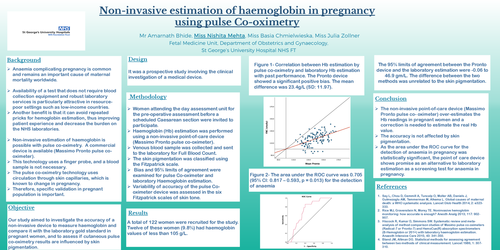
Objective – Anaemia complicating pregnancy is seen relatively commonly and remains an important cause of maternal mortality worldwide. Our study aimed to investigate the accuracy of a non-invasive device to measure Haemoglobin and compare it with the laboratory gold standard in pregnant women, and to assess if cutaneous pulse co-oximetry results are influenced by skin pigmentation.
Design- It was a prospective study involving the clinical investigation of a medical device.
Methods – Women attending the day assessment unit for the pre-operative assessment before a scheduled Caesarean section were invited to participate in this study. Haemoglobin (Hb) estimation was performed using a non-invasive point-of-care device (Massimo Pronto pulse co-oximeter). A venous blood sample was collected and sent to the laboratory for a Full Blood Count. The skin pigmentation was classified using the Fitzpatrick scale. Bias and 95% limits of agreement were examined for pulse Co-oximeter and laboratory Haemoglobin estimation. Variability of accuracy of the pulse Co-oximeter device was assessed in the six Fitzpatrick scales of skin tone.
Results – A total of 122 women were recruited for the study. Twelve of these women (9.8%) had haemoglobin values of less than 105 g/L. The Pronto device showed a significant positive bias. The mean difference was 23.4 (SD: 11.97) g/L. The 95% limits of agreement between the Pronto device and the laboratory estimation were -0.06 to 46.9 gm/L. The difference between the two methods was unrelated to the skin pigmentation. The area under the ROC curve was 0.705 (95% CI: 0.817 – 0.593, p = 0.013) for the detection of anaemia.
Conclusions - The point-of-care device (Massimo Pronto pulse co-oximeter) overestimates the Hb readings in pregnant women and a correction is needed to estimate the real Hb value. The accuracy is unaffected by skin pigmentation. The device may be a potentially useful screening tool in the detection of anaemia in pregnancy in a limited resource setting, but the 95% limits of agreements are relatively wide. Another potentially attractive benefit is that it can avoid repeated pricks and blood samples for haemoglobin estimation, thus improving patient experience and decreasing the burden on the NHS laboratories.