1,830 posters, 67 videos, 75 audios, 29 topics, 22 sessions, 4,727 authors, 1,697 institutions
ePostersLive by SciGen Technologies S.A. All rights reserved.
RCOG World Congress 2023
June 12 - 14, 2023 | London, UK

EP.0240
DOES INDUCTION OF LABOUR HAVE IMPACT ON UTERINE CONTRACTILE ACTIVITY?
Part of Topic
Labour Ward Management
DOES INDUCTION OF LABOUR HAVE IMPACT ON UTERINE CONTRACTILE ACTIVITY?
Objective:
To investigate the impact of induction of labor on uterine contractile activity.
Design:
The incidence of induction of labour (IOL) has risen. We carried out an exploratory, blinded analysis of a randomised controlled trial in which intrauterine (n=736) and external tocodynamometries (n=768) were compared with respect of labour outcomes.
Methods:
This secondary analysis included 686 parturients with singleton pregnancies, gestational age ≥ 37 weeks, foetus in cephalic presentation, and interpretable intrauterine tocography dynamometry during labour. Uterine contractile activity was assessed as intrauterine pressure (MVU), frequency of contractions and basal tonus of uterine muscle (mmHg) during four hours before vaginal delivery or decision of caesarean section. The use of oxytocin was recorded simultaneously. Differences between groups were tested by using the Mann–Whitney U-test and the chi-squared test.
Results:
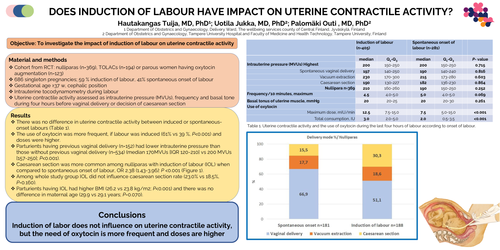
In this cohort, 59% had induction of labour. Parturients having induction of labour had higher BMI than those having spontaneous onset of labour (26.2 vs 23.8 kg/m2; P<0.001) and there was no difference in maternal age (29.9 vs 29.1 years; P=0.070). Uterine contractile activity did not differ according to the onset of labour: maximum intrauterine pressure reached median 200 MVUs [Q1-Q3 150-250] in both groups, P= 0.715); frequency/10 min 4.5 [4.0-5.0] IOL vs 5.0 [4.0-5.0]) spontaneous onset of labour, P= 0.069; basal tone 20 mmHg [20-25] vs. 20 [20-30] respectively, P=0.261). Parity did not affect this result: intrauterine pressure among women without previous vaginal delivery 210 MVUs [160-260] vs. 200 [150-250], P=0.139). The use of oxytocin was more frequent, if labour was induced (61% vs. 39 %, P<0.001) and maximum doses were higher (12.5 mIU/min [7.5-15.0] vs. 7.5 [5.0-15.0]; P<0.001).
Parturients having had previous vaginal delivery (n=152), had lower intrauterine pressure than parturients with no previous vaginal delivery (n=534) (median 170MVUs [120-210] vs 200MVUs [157-250]; P<0.001). Induction of labour did not influence on caesarean section rate (23.0% vs. 18.5% among spontaneous onset of labour; P=0.160) but caesarean section was more common among nulliparas with induction of labour when compared to spontaneous onset of labour (30.3% vs 15.5%, OR 2.38 (1.43 3.96 ); P <0.001.
Conclusions: Induction of labour does not influence on uterine contractile activity, but the need of oxytocin is more frequent and doses are higher.