1,830 posters, 67 videos, 75 audios, 29 topics, 22 sessions, 4,727 authors, 1,697 institutions
ePostersLive by SciGen Technologies S.A. All rights reserved.
RCOG World Congress 2023
June 12 - 14, 2023 | London, UK

EP.0234
Severity of Vitamin D Deficiency among Multi Ethnic Pregnant Population in Birmingham
Poster Presenter
Authors
Affiliations
Part of Topic
Maternal Medicine
(I have used the same dimesnsions as told by RCOG , still its is saying that dimesnions are not same. Kindly let me know if there is any issue after submission.)
Severity of Vitamin D Deficiency among the Multi Ethnic Pregnant Population in Birmingham (UK)
Authors: Miss Ayesha Zafar (clinical fellow, University Hospital Birmingham,UHB) and Mr Irshad Ahmed (consultant, UHB)
Background:
Vitamin D is important for health of the pregnant women and reduces the risk of baby developing rickets. People with darker skin are at more risk, during winter months nearly 75% of adults from Asian, African and Caribbean backgrounds may have low Vitamin D levels.
Department of Health recommends a daily supplementation of 10 micrograms (400units) Vitamin d for all pregnant women. However, this dose may be inadequate for women with severe deficiency.
This study was carried out in the Maternity Units of University Hospitals of Birmingham (UHB) in UK. A significant proportion of our pregnant population is of ethnic minority origin, overweight and diabetic. Also in winter season, low exposure to sunlight exaggerates the existing issue. According to trust guidelines, women with severe deficiency should be treated with much higher dose of vitamin D (10,000 units once week for 6 weeks). Blood vitamin D level of >50nmol/L is regarded as normal, 25-50nmol/L is moderately deficient and <25nmol/L is severe deficient. However, there is no current practice in UK maternities for routine checking of blood Vitamin D level at booking. However, in UHB, some of our pregnant women do have vitamin D levels checked at the booking.
Aim:
To ascertain the prevalence and severity of vitamin D deficiency in our multi ethnic and inner- city pregnant population.
Hypothesis:
All pregnant women at booking should have blood vitamin D levels done and those with low levels should be treated with correct dosage of vitamin D supplement.
Method:
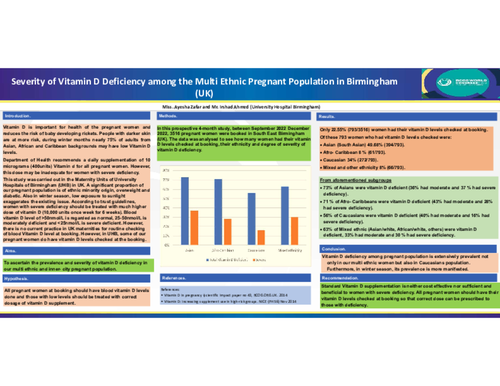
In this prospective 4-month study, between September 2022 December 2022, 3516 pregnant women were booked in South East Birmingham (UK). The data was analysed to see how many women had their vitamin D levels checked at booking, their ethnicity and degree of severity of vitamin D deficiency.
Results:
Only 22.55% (793/3516) women had their vitamin D levels checked at booking.
Of these 793 women who had vitamin D levels checked were:
- Asian (South Asian) 49.68% (394/793)
- Afro- Caribbean 8 % (61/793)
- Caucasian 34% (272/793)
- Mixed and other ethnicity 8% (66/793)
From above subgroups
- 73% of Asians were vitamin D deficient (36% had moderate and 37 % had severe deficiency).
- 71 % of Afro- Caribbeans were vitamin D deficient (43% had moderate and 28% had severe deficiency).
- 56% of Caucasians were vitamin D deficient (40% had moderate and 16% had severe deficiency).
- 63% of Mixed ethnic (Asian/white, African/white, others) were vitamin D deficient, 33% had moderate and 30 % had severe deficiency.
Conclusion:
Vitamin D deficiency among pregnant population is extensively prevalent not only in our multi ethnic women but also in Caucasians population. Furthermore, in winter season, its prevalence is more manifested.
Recommendation:
Standard Vitamin D supplementation is neither cost effective nor sufficient and beneficial to women with severe deficiency. All pregnant women should have their vitamin D levels checked at booking so that correct dose can be prescribed to those with deficiency.
References:
• Vitamin D in pregnancy (scientific impact paper no 43, RCOG.ORG.UK. 2014
• Vitamin D: increasing supplement use in high-risk groups. NICE (PH 56) Nov 2014