1,830 posters, 67 videos, 75 audios, 29 topics, 22 sessions, 4,727 authors, 1,697 institutions
ePostersLive by SciGen Technologies S.A. All rights reserved.
RCOG World Congress 2023
June 12 - 14, 2023 | London, UK

EP.0233
Antenatal corticosteroids administration: better timed in spontaneous vs iatrogenic preterm birth
Poster Presenter
Part of Topic
Hot Topics (Emerging research/issues) in Obstetrics
TITLE
Antenatal Corticosteroids Administration: Better Timed in Spontaneous vs Iatrogenic Preterm Birth
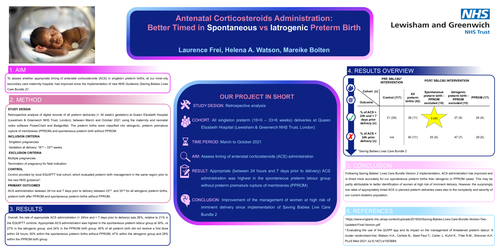
OUR PROJECT IN SHORT
STUDY DESIGN: Retrospective analysis
COHORT: All singleton preterm (16+0 – 33+6 weeks) deliveries at Queen
Elizabeth Hospital (Lewisham & Greenwich NHS Trust, London)
TIME PERIOD: March to October 2021
AIM: Assess timing of antenatal corticosteroids (ACS) administration
RESULT: Appropriate (between 24 hours and 7 days prior to delivery) ACS
administration was highest in the spontaneous preterm labour group
without preterm premature rupture of membranes (PPROM)
CONCLUSION: Improvement of the management of women at high risk of
imminent delivery since implementation of Saving Babies Live Care
Bundle 2
1. AIM
To assess whether appropriate timing of antenatal corticosteroids (ACS) in singleton preterm births, at our inner-city
secondary care maternity hospital, had improved since the implementation of new NHS Guidance (Saving Babies Lives
Care Bundle 2)
2. METHOD
STUDY DESIGN
Retrospective analysis of digital records of all preterm deliveries (< 34 week’s gestation) at Queen Elizabeth Hospital
(Lewisham & Greenwich NHS Trust, London), between March and October 2021 using the maternity and neonatal
notes software PowerChart and BadgerNet. The preterm births were classified into iatrogenic, preterm premature
rupture of membranes (PPROM) and spontaneous preterm birth without PPROM.
INCLUSION CRITERIA
Singleton pregnancies
Gestation at delivery: 16+0 – 33+6 weeks
EXCLUSION CRITERIA
Multiple pregnancies
Termination of pregnancy for fetal indication
CONTROL
Control provided by local EQUIPTT trial cohort, which evaluated preterm birth management in the same region prior to
the new NHS guidance2.
PRIMARY OUTCOMES
ACS administration between 24 hrs and 7 days prior to delivery between 22+0 and 33+6 for all iatrogenic preterm births,
preterm birth after PPROM and spontaneous preterm births without PPROM.
3. RESULTS
Overall, the rate of appropriate ACS administration (> 24hrs and < 7 days prior to delivery) was 26%, relative to 21% in
the EQUIPTT controls. Appropriate ACS administration was highest in the spontaneous preterm labour group at 30%, vs
27% in the iatrogenic group, and 24% in the PPROM birth group. 40% of all preterm birth did not receive a first dose
within 24 hours, 50% within the spontaneous preterm births without PPROM, 47% within the iatrogenic group and 29%
within the PPROM birth group.
4. CONCLUSION
Following Saving Babies’ Lives Care Bundle Version 2 implementation, ACS administration has improved and
is timed more accurately for our spontaneous preterm births than iatrogenic or PPROM cases. This may be
partly attributable to better identification of women at high risk of imminent delivery. However, the surprisingly
low rates of appropriately timed ACS in planned preterm deliveries owes also to the complexity and severity of
our current obstetric population.
5. REFERENCES
https://www.england.nhs.uk/wp-content/uploads/2019/03/Saving-Babies-Lives-Care-Bundle-Version-Two-
Updated-Final-Version.pdf
2 Evaluating the use of the QUiPP app and its impact on the management of threatened preterm labour: A
cluster randomised trial, Watson H.A., Carlisle N., Seed Paul T., Carter J., Kuhrt K., Tribe R.M., Shennan A.H.
PLoS Med 2021 Jul 6;18(7):e1003689.