1,830 posters, 67 videos, 75 audios, 29 topics, 22 sessions, 4,727 authors, 1,697 institutions
ePostersLive by SciGen Technologies S.A. All rights reserved.
RCOG World Congress 2023
June 12 - 14, 2023 | London, UK

EP.0228
Improving Obstetricians' Accordance in Fetal Monitor Interpretation During Childbirth
Poster Presenter
Part of Topic
Hot Topics (Emerging research/issues) in Obstetrics
Introduction: Despite decades of usage of the fetal monitor and implementation of various guidelines to improve uniformity and accuracy of interpretation, it is evident that the fetal monitor is prone to errors, leads to high false-positive predictive value and to a rise in the rate of cesarean sections, without reducing the rate of cerebral palsy or negative perinatal outcomes. Moreover, past studies found high inter-observer variability in interpretation, emphasizing the inconsistent nature of decision-making in the delivery room.
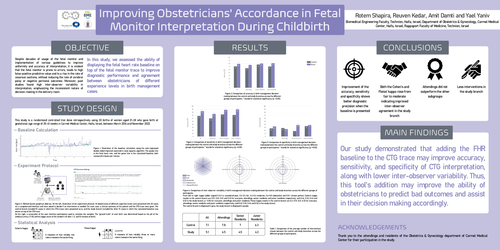
Objective: In this study, we assessed the ability of displaying the fetal heart rate baseline on top of the fetal monitor trace to improve diagnostic performance and agreement between obstetricians of different experience levels in birth management cases.
Study Design: This study is a randomized controlled trial done retrospectively using 30 births of women aged 21-38 who gave birth at gestational age range of 35-41 weeks in Carmel Medical Center, Haifa, Israel, between March 2016 and November 2022. 15 births were included in the control branch and the other 15 were included in the study branch.
Cardiotocography (CTG) traces of births included in the control branch were presented to participants as is, and those of the study branch were presented with a calculated fetal heart rate baseline signal on top of the trace. The baseline signal was calculated using the auto-regressed double-sided improved asymmetric least squares algorithm.
18 obstetricians participated in the trial: 6 attendings, 6 senior residents (in their 5th or last year of residency) and 6 junior residents (in their 1st or 2nd year of residency). Each participant was asked to determine if an intervention is needed for each birth using a web interface based on the CTG trace and clinical summary of the patient.
The “ground truth” of each case was determined based on the pH measurement of the umbilical cord artery and the Apgar score 1-, 5-, and 10-minutes post-birth. Each branch of the trial included 5 bad outcomes and 10 good outcomes according to this standard.
To determine diagnostic precision performance, accuracy, sensitivity, and specificity were calculated. Accuracy signifies how correct a series of measurements are on average, indicating absence of bias. Sensitivity is the true positive rate and specificity is the true negative rate. To assess inter-observer variability, we utilized Cohen’s kappa and Fleiss’ kappa. Cohen’s kappa is a measure of how reliably two raters measure the same thing. Fleiss’ kappa is a measure of how reliably three or more raters measure the same thing.
Results: The average accuracy in the control branch was 69% compared to 78% in the study branch (p<0.05) when examining diagnostic precision. The average sensitivity rose form 67% in the control branch to 83% in the study branch (p<0.05), and was statistically significant for all subgroups. Specificity improved from 26% to 32% when showing the baseline, a significant change was achieved for the senior residents only.
The kappas are measured in intervals of 0.2: 0-0.2 is poor, 0.2-0.4 is fair, 0.4-0.6 is moderate, 0.6-0.8 is substantial, 0.8-1 is almost perfect. Cohens’ kappa for the study branch remained fair, and rose to Moderate in the study branch. Fleiss’ kappa rose in the same manner.
The number of interventions was documented also, showing an average of 7.1 interventions in the control branch compared to 5.1 interventions in the study branch.
Conclusions: First, we found better diagnostic performance when the baseline was shown as accuracy, sensitivity and specificity were improved. Second, improvement of Cohen’s and Fleiss’ kappa indicated stronger agreement in the study branch. Third, we found that counter to our expectations, attendings did not outperform the other subgroups. Last, we saw less interventions in the study branch.
Take home message: Our study demonstrated that adding the FHR baseline to the CTG trace may improve accuracy, sensitivity, and specificity of CTG interpretation, along with lower inter-observer variability. Thus, this tool’s addition may improve the ability of obstetricians to predict bad outcomes and assist in their decision making accordingly.