1,830 posters, 67 videos, 75 audios, 29 topics, 22 sessions, 4,727 authors, 1,697 institutions
ePostersLive by SciGen Technologies S.A. All rights reserved.
RCOG World Congress 2023
June 12 - 14, 2023 | London, UK

EP.0210
BILATERAL INTERNAL ILIAC ARTERY BALLOON OCCLUSION DURING CAESAREAN SECTION FOR PREVENTING HAEMORRHAGE
Poster Presenter
Authors
Konstantia Bakalianou, Miltiadis Krokidis, Michail Litos, Dimitra Vasileiadou, Panagiotis Papadopoulos, Eirini Lykoudi, Aristeidis Tzeferakos, Spyridoula Papadia, Charikleia Triantopoulou
Affiliations
Department of Obstetrics & Gynecology, Konstantopouleio General Hospital, Interventional Radiology Unit, 1st Department of Radiology, Aretaieio Hospital, Department of Anesthesiology, Konstantopouleio General Hospital, Department of Radiology, Konstantopouleio General Hospital
Part of Topic
High Risk Pregnancy
Objective
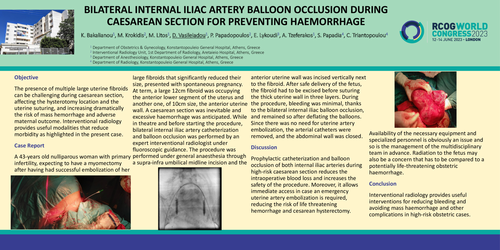
The presence of multiple large uterine fibroids can be challenging during caesarean section, affecting the hysterotomy location and the uterine suturing, and increasing dramatically the risk of mass hemorrhage and adverse maternal outcome. Interventional radiology provides useful modalities that reduce morbidity as highlighted in the present case.
Case Report
A 43-years old nulliparous woman with primary infertility, expecting to have a myomectomy after having had successful embolization of her large fibroids that significantly reduced their size, presented with spontaneous pregnancy. At term, a large 12cm fibroid was occupying the anterior lower segment of the uterus and another one, of 10cm size, the anterior uterine wall. A caesarean section was inevitable and excessive haemorrhage was anticipated. While in theatre and before starting the procedure, bilateral internal iliac artery catheterization and balloon occlusion was performed by an expert interventional radiologist under fluoroscopic guidance. The procedure was performed under general anaesthesia through a supra-infra umbilical midline incision and the anterior uterine wall was incised vertically next to the fibroid.
After safe delivery of the fetus, the fibroid had to be excised before suturing the thick uterine wall in three layers. During the procedure, bleeding was minimal, thanks to the bilateral internal iliac balloon occlusion, and remained so after deflating the balloons. Since there was no need for uterine artery embolization, the arterial catheters were removed, and the abdominal wall was closed.
Discussion
Prophylactic catheterization and balloon occlusion of both internal iliac arteries during high-risk caesarean section reduces the intraoperative blood loss and increases the safety of the procedure. Moreover, it allows immediate access in case an emergency uterine artery embolization is required, reducing the risk of life threatening hemorrhage and cesarean hysterectomy. Availability of the necessary equipment and specialized personnel is obviously an issue and so is the management of the multidisciplinary team in advance. Radiation to the fetus may also be a concern that has to be compared to a potentially life-threatening obstetric haemorrhage.
Conclusion
Interventional radiology provides useful interventions for reducing bleeding and avoiding mass haemorrhage and other complications in high-risk obstetric cases.