1,830 posters, 67 videos, 75 audios, 29 topics, 22 sessions, 4,727 authors, 1,697 institutions
ePostersLive by SciGen Technologies S.A. All rights reserved.
RCOG World Congress 2023
June 12 - 14, 2023 | London, UK

EP.0209
A challenging case of Huntington’s disease in pregnancy and outcome
Poster Presenter
Authors
Affiliations
Part of Topic
High Risk Pregnancy
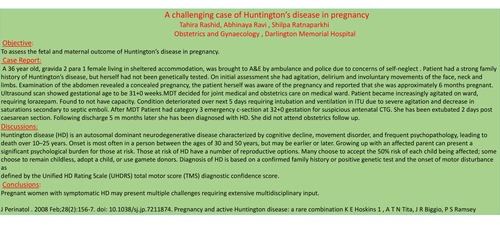
TITLE: A challenging case of Huntington’s disease in pregnancy
Tahira Rashid, Abhinaya Ravi , Shilpa Ratnaparkhi
Obstetrics and Gynaecology , Darlington Memorial Hospital
Objective:
To assess the fetal and maternal outcome of Huntington’s disease in pregnancy.
Case Report:
A 36 year old, gravida 2 para 1 female living in sheltered accommodation, was brought to A&E by ambulance and police due to concerns of self-neglect . Patient had a strong family history of Huntington’s disease, but herself had not been genetically tested. On initial assessment she had agitation, delirium and involuntary movements of the face, neck and limbs. Examination of the abdomen revealed a concealed pregnancy, the patient herself was aware of the pregnancy and reported that she was approximately 6 months pregnant. Ultrasound scan showed gestational age to be 31+0 weeks.MDT decided for joint medical and obstetrics care on medical ward. Patient became increasingly agitated on ward, requiring lorazepam. Found to not have capacity. Condition deteriorated over next 5 days requiring intubation and ventilation in ITU due to severe agitation and decrease in saturations secondary to septic emboli. After MDT Patient had category 3 emergency c-section at 32+0 gestation for suspicious antenatal CTG. She has been extubated 2 days post c-section. Following discharge 5 m months later she has has been diagnosed with HD. She did not attend obstetrics follow up.
Discussions:
Huntington disease (HD) is an autosomal dominant neurodegenerative disease characterized by cognitive decline, movement disorder, and frequent psychopathology, leading to death over 10–25 years. Onset is most often in a person between the ages of 30 and 50 years, but may be earlier or later. Growing up with an affected parent can present a significant psychological burden for those at risk. Those at risk of HD have a number of reproductive options. Many choose to accept the 50% risk of each child being affected; some choose to remain childless, adopt a child, or use gamete donors. Diagnosis of HD is based on a confirmed family history or positive genetic test and the onset of motor disturbance as defined by the Unified HD Rating Scale (UHDRS) total motor score (TMS) diagnostic confidence score.
Conclusions:
Pregnant women with symptomatic HD may present multiple challenges requiring extensive multidisciplinary input.
J Perinatol. 2008 Feb;28(2):156-7.doi: 10.1038/sj.jp.7211874. Pregnancy and active Huntington disease: a rare combination